投稿者: admin

  • My First Cycling Trip in Taiwan Day 2

    My First Cycling Trip in Taiwan Day 2

    このブログ記事の翻訳を進行中です。もうすぐ完成しますので、後ほど再度ご確認ください。ご不便をおかけして申し訳ありません。現在は、こちらで提供されているGPXルートや地図などの情報を自由にご利用ください。

    16 April 2009

    I hate cycling among busy traffic but we decided to stay in this busiest city of Taiwan the next day just in case there were any issues with the bikes. We also needed to buy SIM cards and go to the bank. These were the days when mobile data has not yet become as important as oxygen. I was traveling with my TREO 650 and film camera Nikon F801s. I had nothing to share instantly on social media. But we still needed to be able to call the hotels for room reservation and stay connected with each other. Today, if you need mobile data, you can buy a SIM card at the airport with a package of unlimited data within a fixed period. These are tailor-made for tourists  and the procedure is quick and easy. It took only 5 minutes to complete the transaction. And Nope! It’s not more expensive. It’s actually a real bargain. Your only concern is whether your flight is arriving too late and those shops will be closed already. 

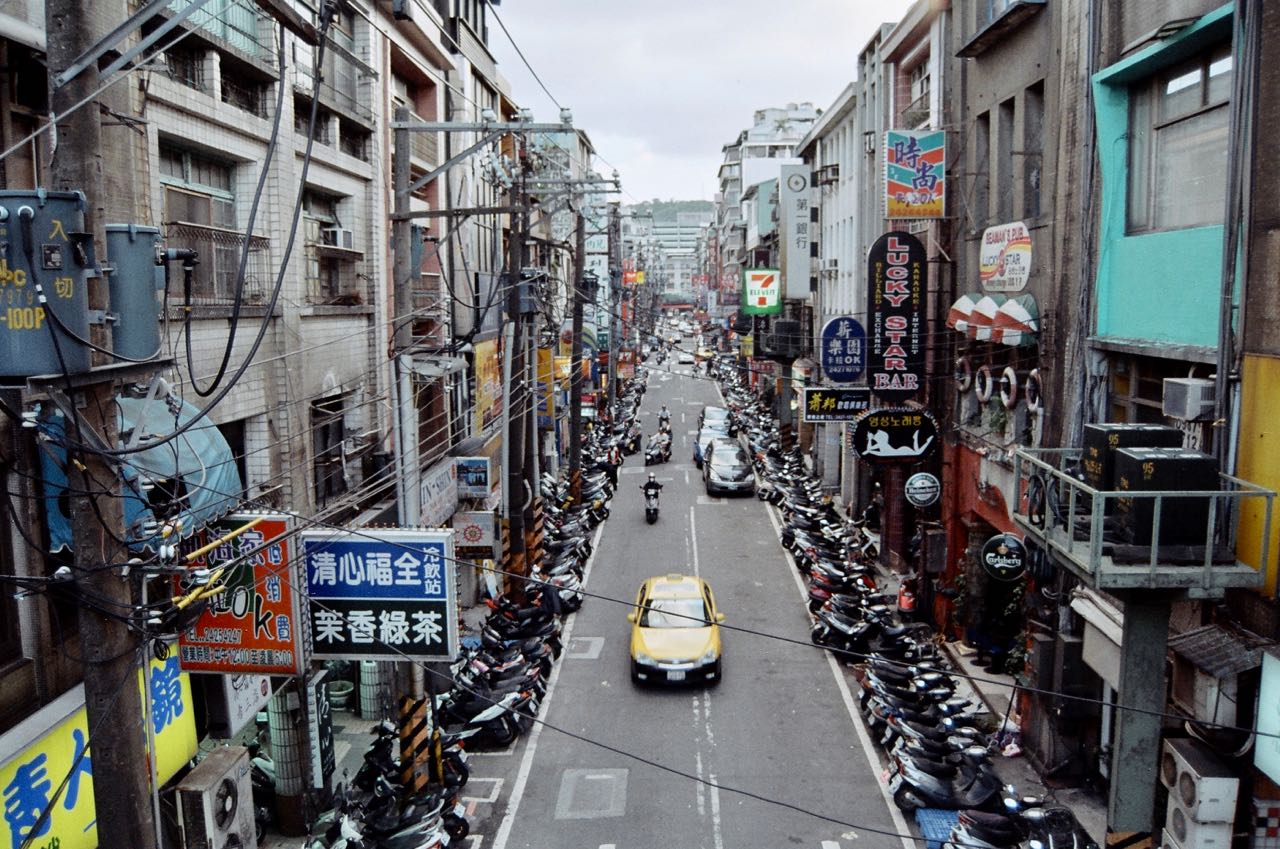
    We roamed in Taipei city on our bicycles with the overwhelming scooters, which made me feel like traveling with massive groups of hornets. Our touring bikes have drawn some attention from passersby.  “Jia You! (add oil) some shouted at us with smiles. They probably thought we were making the 1,000km-around-the-island trip and wanted to give us some big pushes. Although Taiwan is home to the world’s two biggest bicycle manufacturers and has been making bikes for the world for decades, people here prefer their scooters for daily commute. Then there was this movie Island Etude released in 2007, about a hearing impaired college student making the round-the-island tour in Taiwan. The idea has been so impressive and inspiring that people started doing the tour themselves. It has kind of become a coming of age ceremony or a pilgrimage. No wonder we received so much encouragement. To me, it’s like giving a salute to the place. 

    Slowly we discovered some special rules for scooters and bicycles (機慢車). For those who don’t read Chinese characters, it might be tricky to figure it out. The following are some general ideas that I hope you may find useful. Click on the links of Chinese Characters to see the signs. 

    The Free Ways 國道 (sign: white, five-petal flower with a number inside), the red badge Provincial Highways (Express Ways, sign: red badge with numbers) and Urban Express Ways are not for scooters and bicycles. 

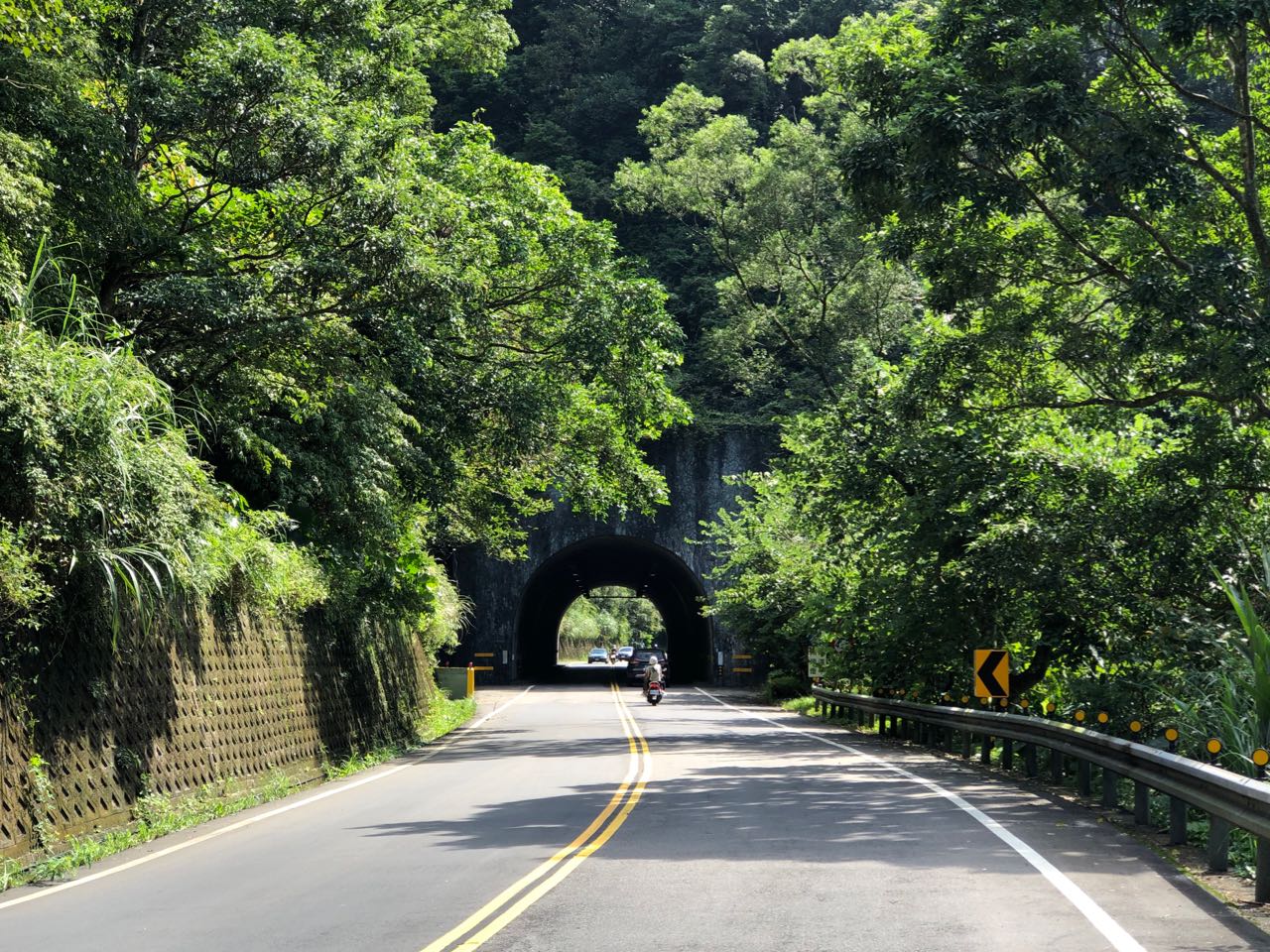
    Everyone can use the Provincial Highways with blue badges (省道),  County or City Highways (縣道), Township and District Roads (鄉道) and Industrial Roads (產業道). In those rural areas, it’s perfectly OK to use the overpasses, bridges or tunnels on these roads. Remember to turn on your lights in the tunnels.

    Rural Tunnel
    A rural tunnel meant to be shared among cars, scooters and bicycles

    Sometimes, the lanes close to the centre (left) are not for slow vehicles. You would see the yellow Chinese characters 禁行機車 (No Scooters) arranged vertically on the tarmac. There are also lanes built for slow vehicles (機慢車道). In front of some traffic lights, there are boxes for slow vehicles to wait for the green light. Bikes are slower especially on starting; stay close to the sidewalks to give way to the others. On most intersections, slow vehicles should follow the two-stage-left-turning rule (二段式左轉), i.e. after going through a green light (the first stage), go to the left turning waiting zone, another box (左轉待轉區). You would be looking at a new traffic light. Wait for the new green light and go (the second stage). When you are not so sure, follow the scooters.  

    The bikes turned out to be in perfect condition. There were showers of rain but we were ready! Nous étions prêts!
  • My First Cycling Trip in Taiwan Day 3

    My First Cycling Trip in Taiwan Day 3

    このブログ記事の翻訳を進行中です。もうすぐ完成しますので、後ほど再度ご確認ください。ご不便をおかけして申し訳ありません。現在は、こちらで提供されているGPXルートや地図などの情報を自由にご利用ください。

    17 April 2009

    The third day, we started our cycle around the island tour in the drizzle. The preferred/recommended route was supposed to be cycling to Bali Old Street at the left bank of Tamsui River and then take the ferry from the Bali Ferryboat Wharf to the Tamsui Old Street. But we couldn’t. Why? Not my fault. We had a GPS with the proper check points set but it was not mounted on my bike. I just followed John. We made it to a wharf but there was no ferry. We thought that those ferries might only be in services on particular days. But that is not true. The ferries run daily. We just went to the wrong wharf. Anyway, we managed to bike to Tamsui around lunchtime as the drizzle became showers. We scurried into a seafood restaurant for shelter and for lunch. In order to boost up my morale, I ordered one of my favourite dishes, sautéed crab. It was expensive and tasteless. Oh no! I forgot to pick the crab by myself from the tank. They must have cooked a dying one for me. Sigh……!

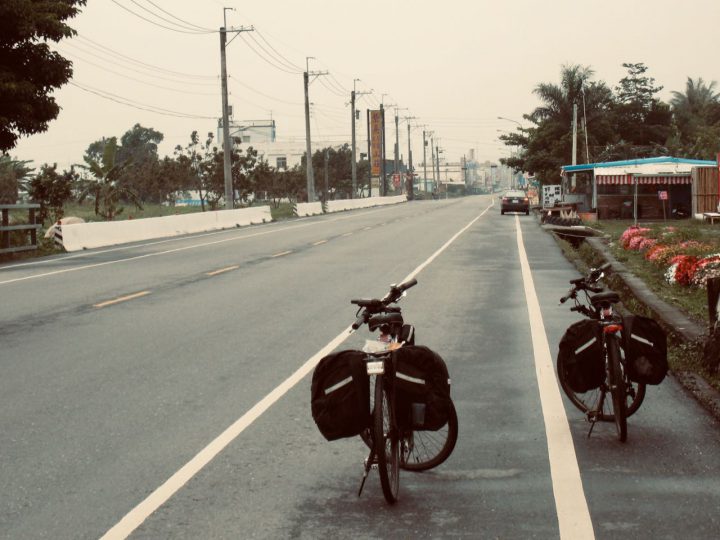
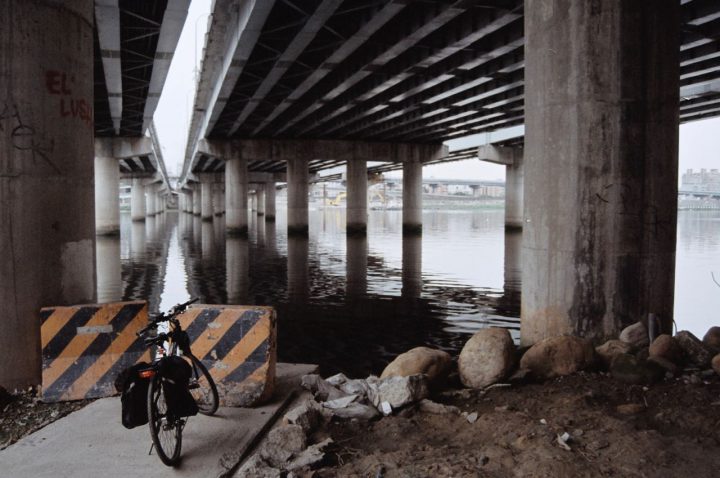
    cyclist on a wharf and Guandu bridge
    Wrong wharf, no ferries. the red bridge behind has a lane especially for bikes connecting Bali to the north coast.

    After our disappointing lunch, at least the rain stopped. And as we reached the outskirts of the city on the Provincial Highway No. 2, swarms of scooters and speeding cars disappeared. (Actually, Taipei is a great place to cycle if one can find the bikeways on the riverbanks.)  There were some cafes and interesting spots. We just stopped briefly because we did not know where to stay for that night.

    Township Road
    Township Road 北11 Chexin Road, a detour from Provincial Highway No. 2. Even less traffics

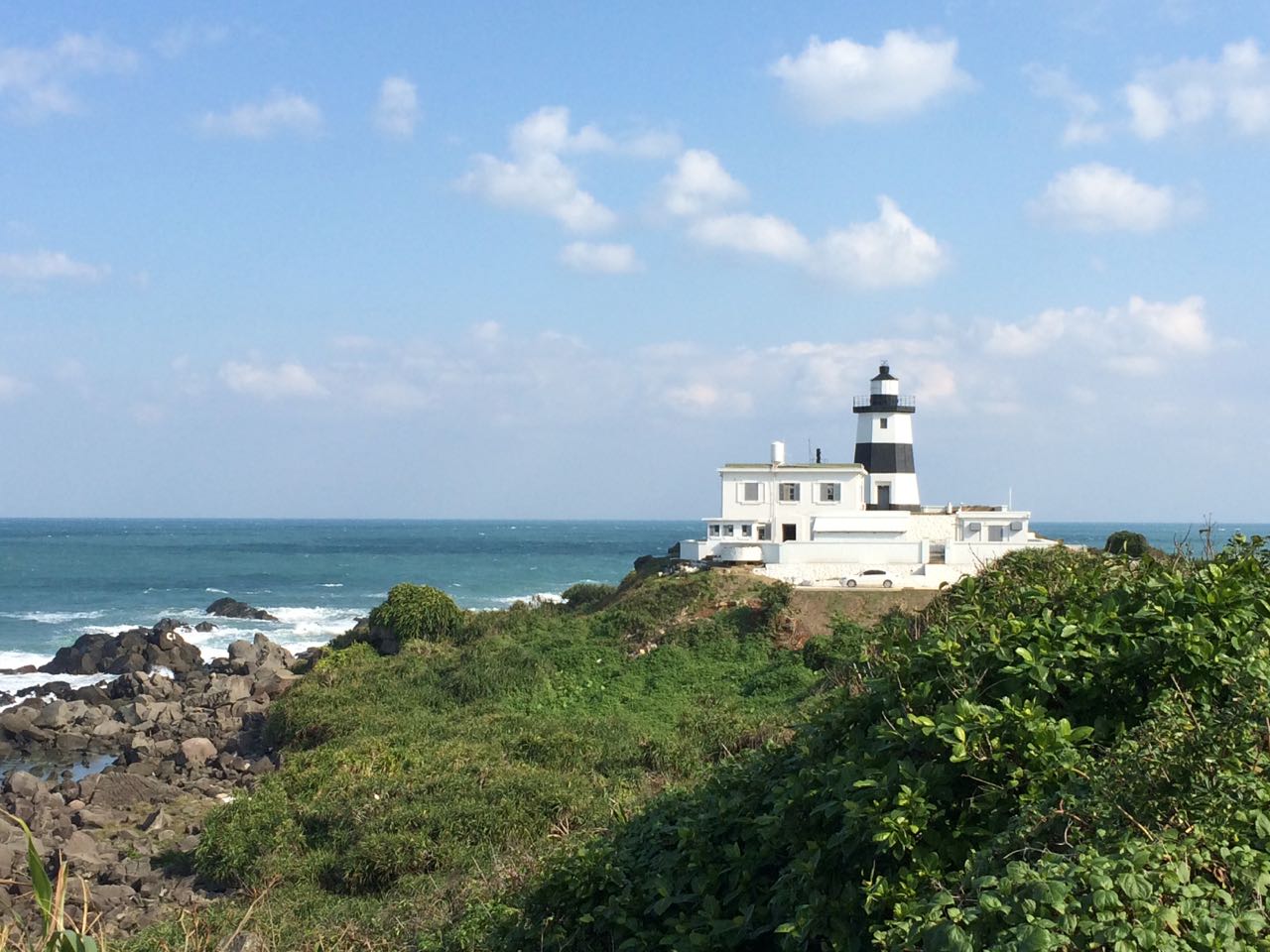
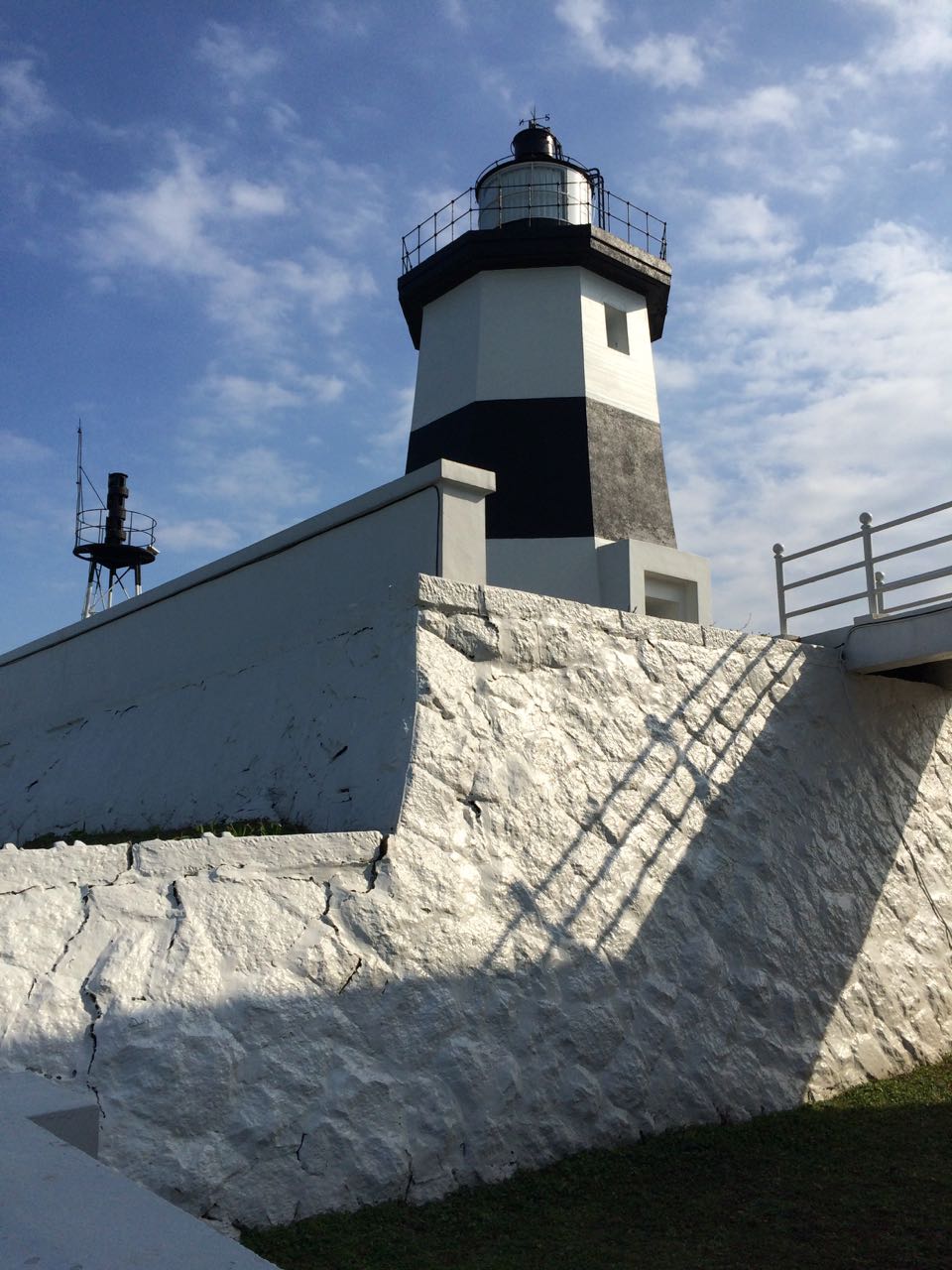
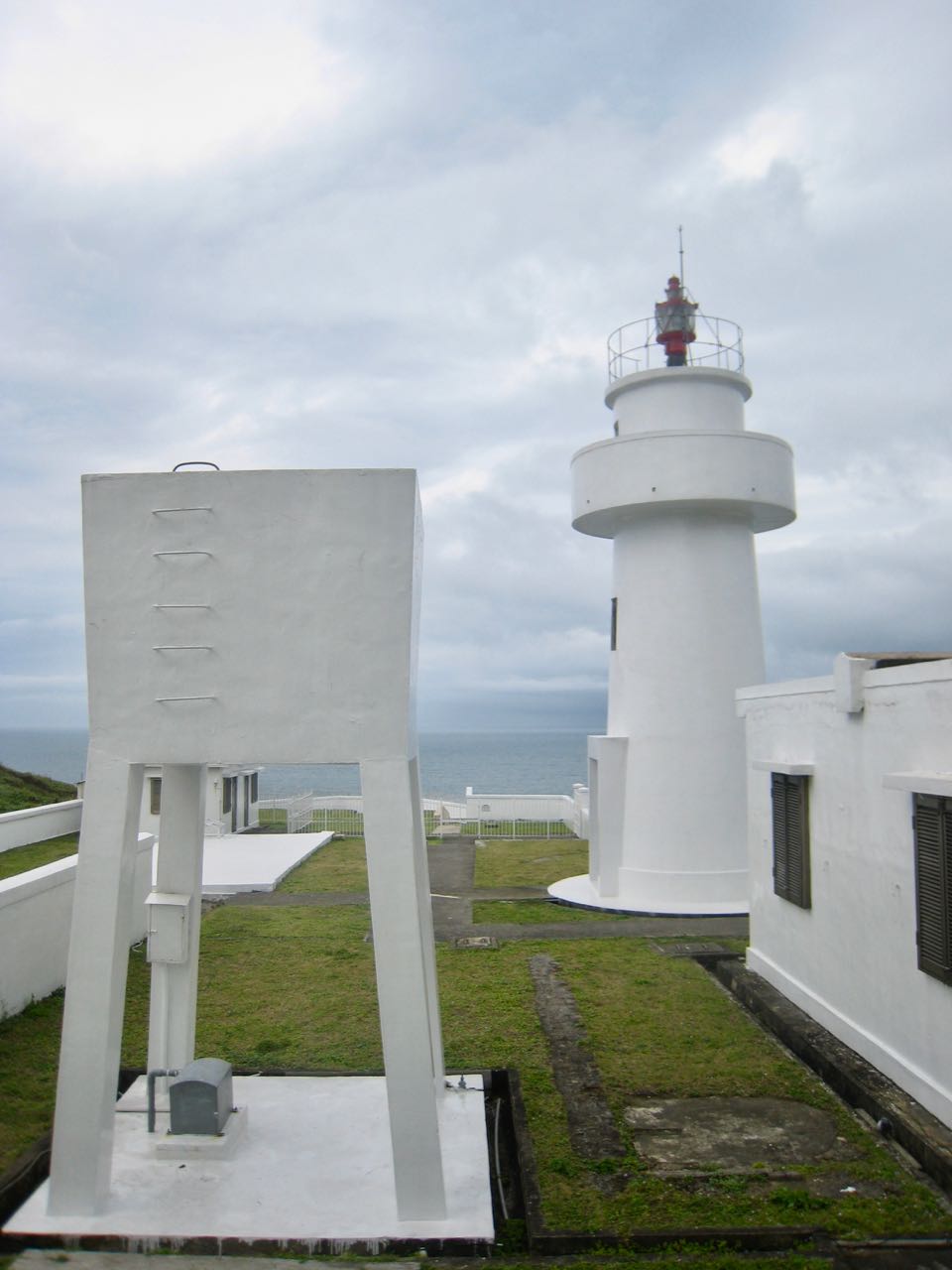
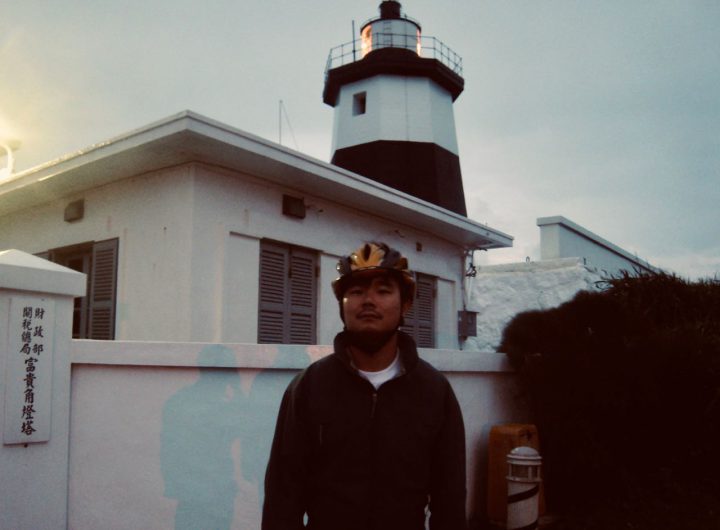
    Then we reached the northern tip of the island, Fugueijiao Lighthouse (富貴角燈塔), when the sun was setting. I love lighthouses. They are altruistic, beautiful, committed and lonely. In the past, there were lighthouse keepers who would play chess with their colleagues on shore by flashing morse codes to the clouds. Read this story, The Fastnet Lighthouse on the Economist. The life of Fugueijiao Lighthouse keepers (if any) should be easier. The lighthouse sits next to a fishing port and some tourist spots and within an hour’s drive from the city. 

    I didn’t care that it’s going to be dark soon. I wanted to take a good look at the lighthouse. We followed the pleasant foot path to the lighthouse and then the pristine buildings appeared with a perfect angle for taking pictures. The lighthouse is a 14.3m octagonal structure with black stripes, which is supposed to improve the visibility in the thick fog. I could only look at it from outside the gate because it was not open to public until 2015.  It opens Tuesday to Sunday, 09:00 – 18:00 (summer), 09:00 – 17:00 (winter).

    Leaving Fugueijiao, we found ourselves cycling in total darkness. It was perfectly safe but we still had not found a place to sleep yet. After 14km of pedalling on the dark coastal highway, I saw a shimmering light. It wasn’t Hotel California; it’s a coffee shop looking like a traditional building on the Greek island Santorini. We loaded up chunks of calories-rich cheese cakes and coffee into our stomachs there and then a kind staff member offered to help us finding a place to stay. She called a homestay owner nearby and told us to meet him at the next 7-eleven. The owner, riding a scooter, led us to his place. That’s the first night of our cycling tour. We had a good chat and played snooker with the owner before having a sound sleep in a clean bedroom big enough to house 6 people.

  • My First Cycling Trip in Taiwan Day 4

    My First Cycling Trip in Taiwan Day 4

    このブログ記事の翻訳を進行中です。もうすぐ完成しますので、後ほど再度ご確認ください。ご不便をおかけして申し訳ありません。現在は、こちらで提供されているGPXルートや地図などの情報を自由にご利用ください。

    18 April 2009

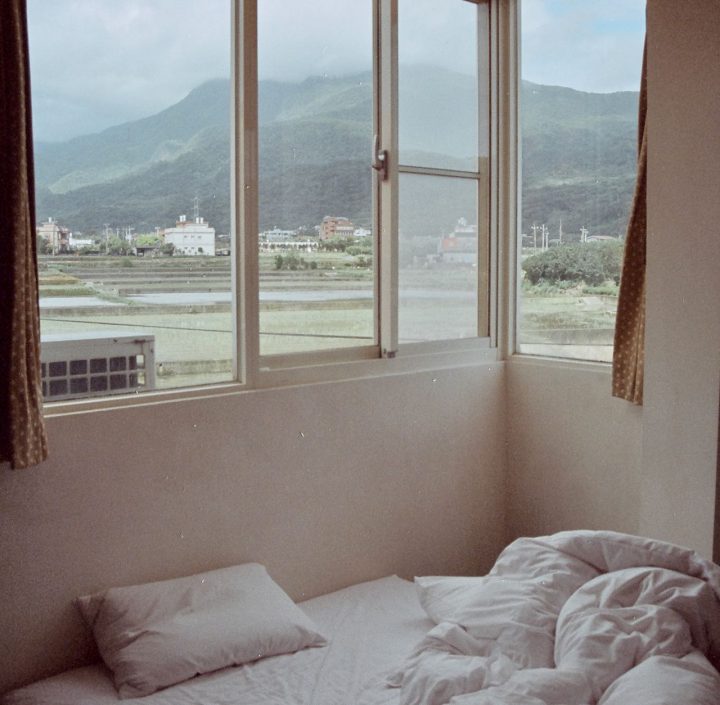
    The next morning, I woke to a rural village surrounded by paddy fields and ponds in the Jinshan District. Breakfast, steamed meat buns, were ready on the table. I guess most homestays in Taiwan would serve breakfast. We were so refreshed and ready for another day of pedalling. But no, not yet! I did not remember having a proper dinner the previous day. We went to the Jinshan Old Street to buy some brined duck meats. 

    As I was leaving the homestay, I was so impressed that the trails were well maintained and laid with asphalt. The garbages were taken care of properly. The government has put in a lot of effort to deal with this since 1989. Visitors to Taiwan must have heard a loud, raw electronic melody every evening. These are garbage trucks summoning garbages. Recyclable items are collected free of charge. Kitchen wastes are diverted to pig farms. And the rest, before collected by the truck, must be put inside a certain kind of bags sold by the local government with levies to fund the operation. So, we should always ask for permission to use the garbage cans in some small shops. I was quite embarrassed that I had to discard the duck meat packing in a 7-Eleven. 

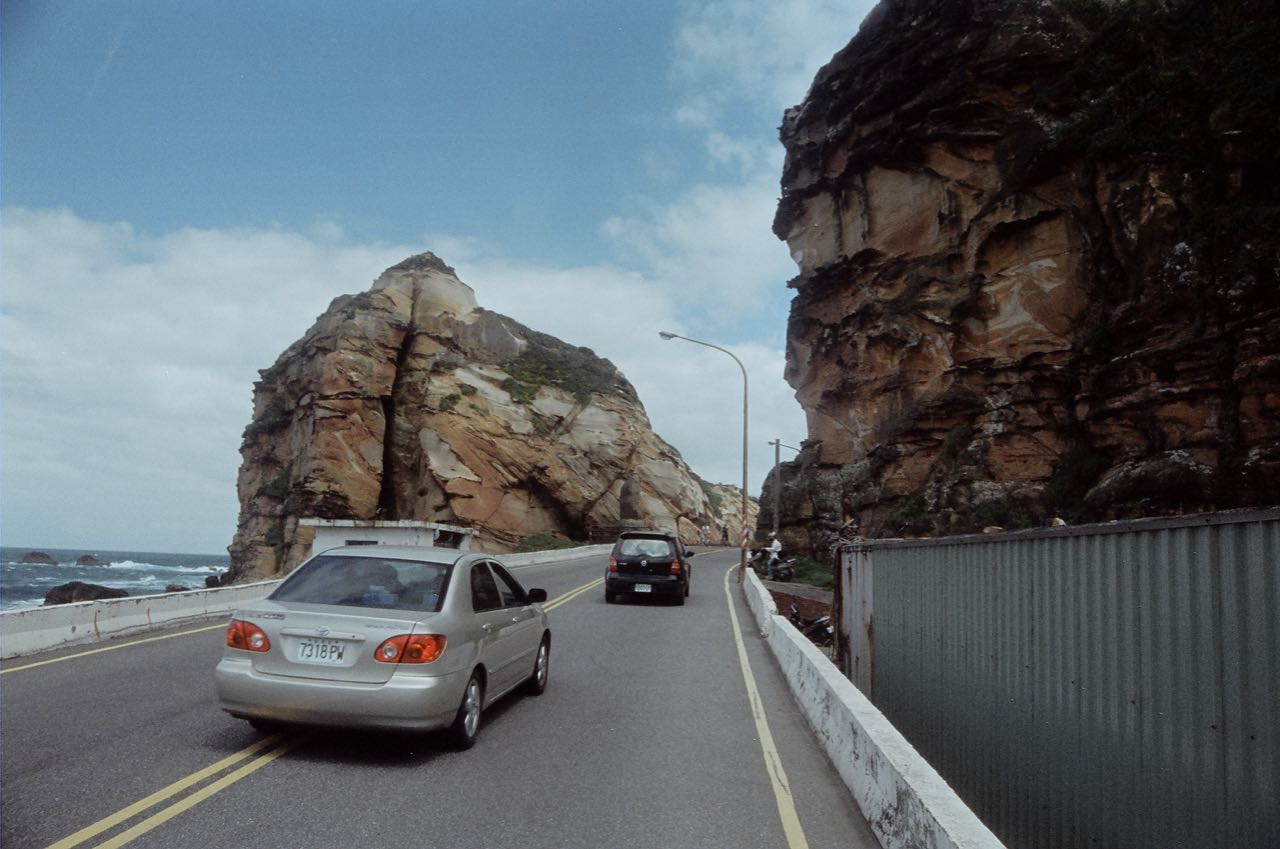
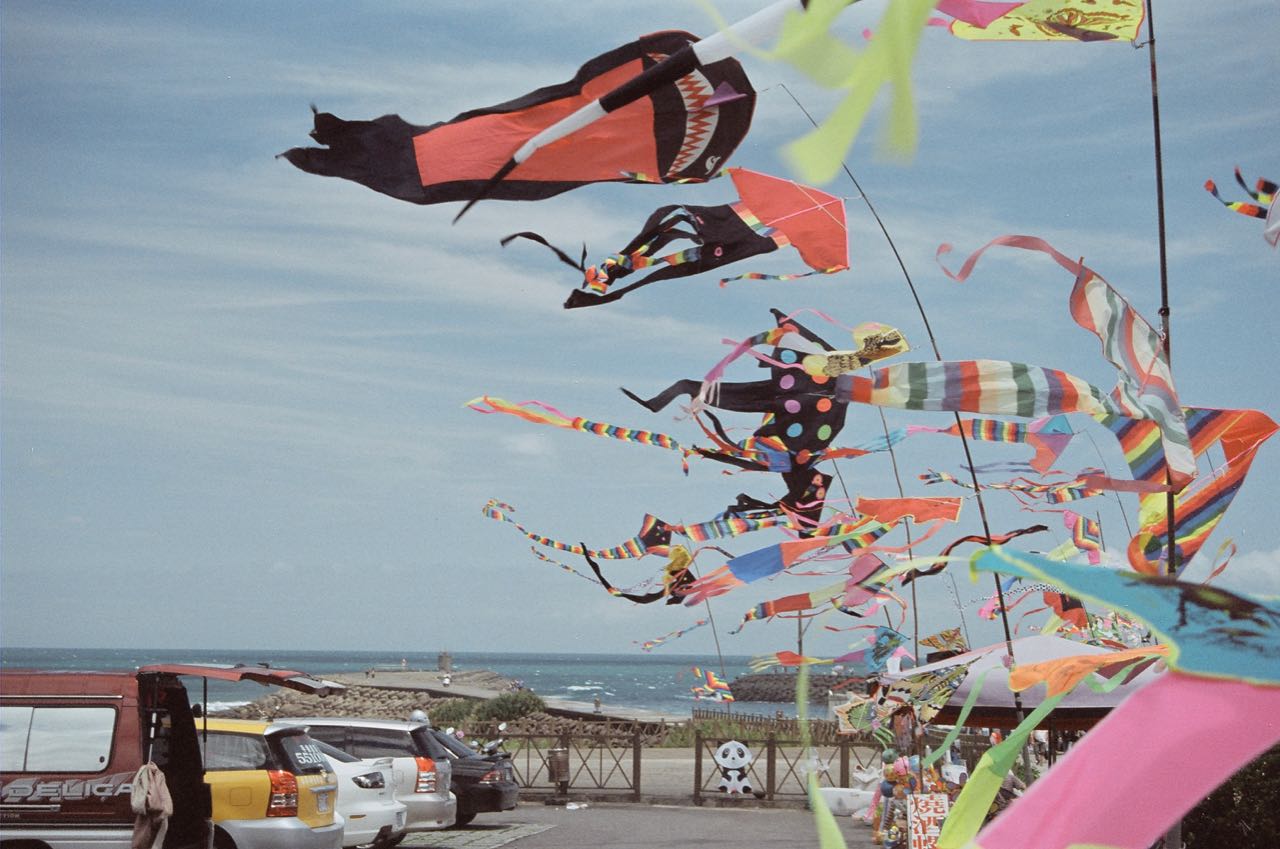
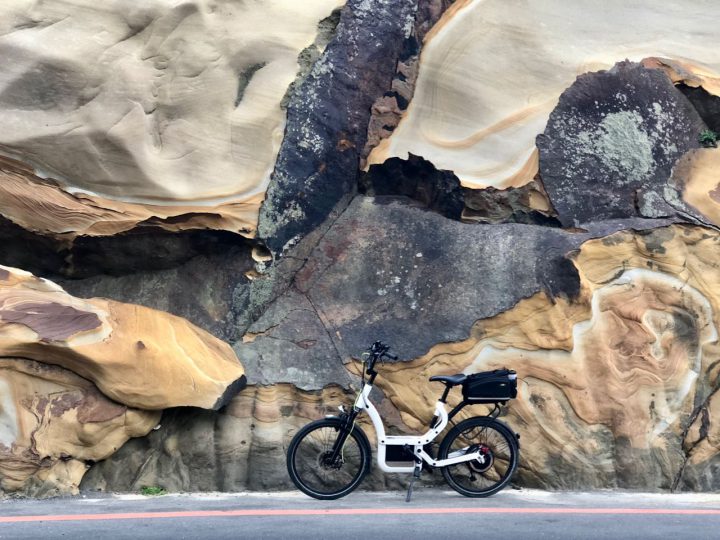
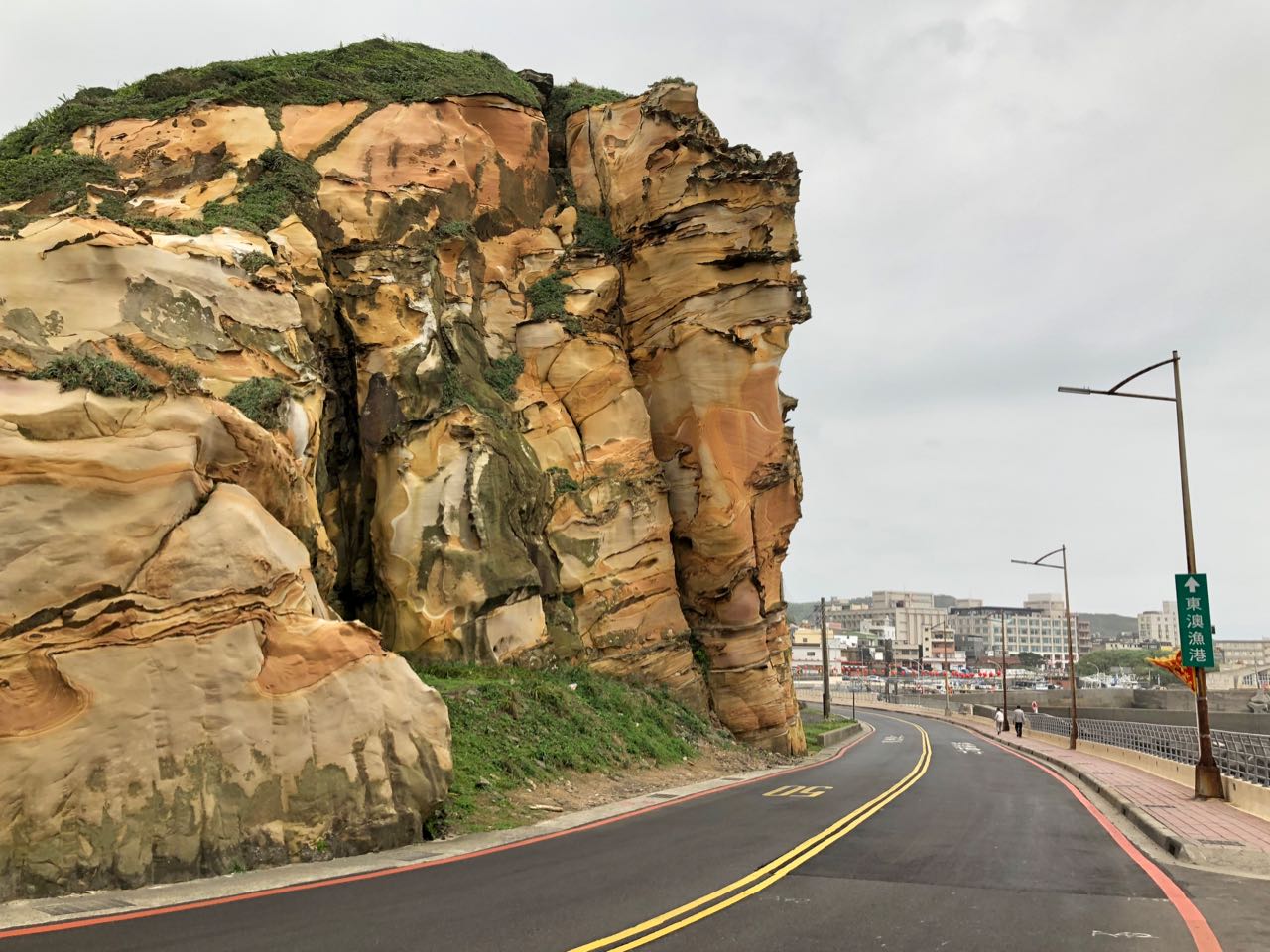
    Gone was the dull sky. We had a sunny day with clear blue sky on the second day of our cycling trip. It looked particularly great with the colourful kites flying over a pier and the orange sandstone formations in the Yeliu Geopark in Wanli. There is this famous Queen’s Head inside the paid area which resembles the profile of Queen Elizabeth I at a certain angle. I used to think it’s Queen Millennia that they are talking about. Back in the 1960’s, the sculpture did look like a queen in real life. After half a century of erosion,   her neck got chipped thinner and thinner, making her look rather like Yukino Yayoi (雪野 弥生) in the manga, Millennial Queen. Given the speed of erosion, the neck won’t be able to support the head for another decade, not to mention a thousand years. After taking a poll in which more than 60% of the voters agreed to take proactive measures to save the sculpture, the Tourism Bureau has tested various methods on other pedestal rocks in the vicinity to stop the erosion process. The results were unsatisfactory. Nothing can help save the queen yet.

    After cycling in solitude for so many hours, Yeliu was a great place to hang around for its lively atmosphere. But we did not buy tickets and get inside the Geopark. We were in the biking mode. We would rather stick with our bikes and spend more time on the north coastal line and then head to the port city Keelung. We did not know how long it would take. We were told during lunch that there was a flat costal bikeway to Keelung. But this nice path has eluded us. We ended up climbing 180m with the busy traffic and breathed in lots of exhaust fumes from the cars and scooters before reaching the top. If you want to know how to find the easy path from Wanli to Keelung, check out my post here.

    Keelung city is home to the third biggest port of Taiwan. It has been the northern gate for the island and strategically important for the past century. Numerous forts were built to guard the city against invaders and there are more than ten remains open to public. With two freeways and two railway lines starting there, the city is supposed to become even more prosperous. But its development has been limited by the surrounding hills. Narrow streets and old buildings are squeezed into the small area around the port, the others scattered in the hilly suburbs which consists of 95% of the city. Lacking space for renewal, Keelung remains more or less unchanged overtime. It’s like going back in time as we descended into the city centre. We checked into a small hotel and asked for a place to keep our bicycles. A staff member kindly brought us to their underground parking lots and let us use one of their mechanized parking systems. So much effort to squeeze more cars into an underground place. 

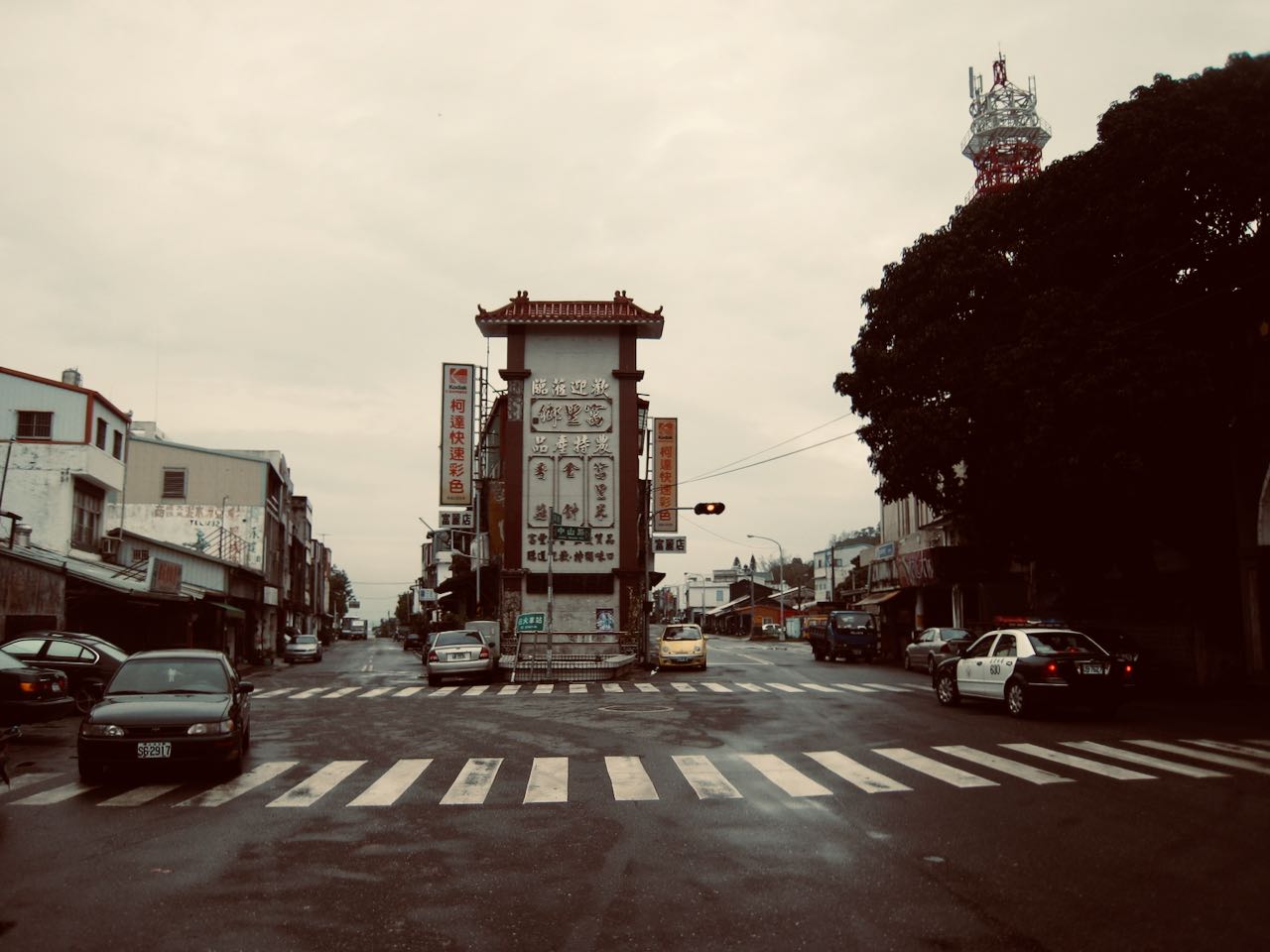
    Street of Kee Lung

    While John was taking a rest in the hotel room, I took a walk and had the most delicious squid soup I have ever had at a food stall in an alley. I recommended it to John but I was not able to find the food stall again. The night market in Keelung has many great snacks to offer but nothing could compare to that squid soup. I even tried to find the store the second time when I was bike touring with Lois but also to no avail. 

    That was our two-day ride on the north coastal line. The next day, we would head east and cycle on the north east coastal line from Keelung to Yilan. 

  • My First Cycling Trip in Taiwan Day 5

    My First Cycling Trip in Taiwan Day 5

    このブログ記事の翻訳を進行中です。もうすぐ完成しますので、後ほど再度ご確認ください。ご不便をおかけして申し訳ありません。現在は、こちらで提供されているGPXルートや地図などの情報を自由にご利用ください。

    19 April 2009

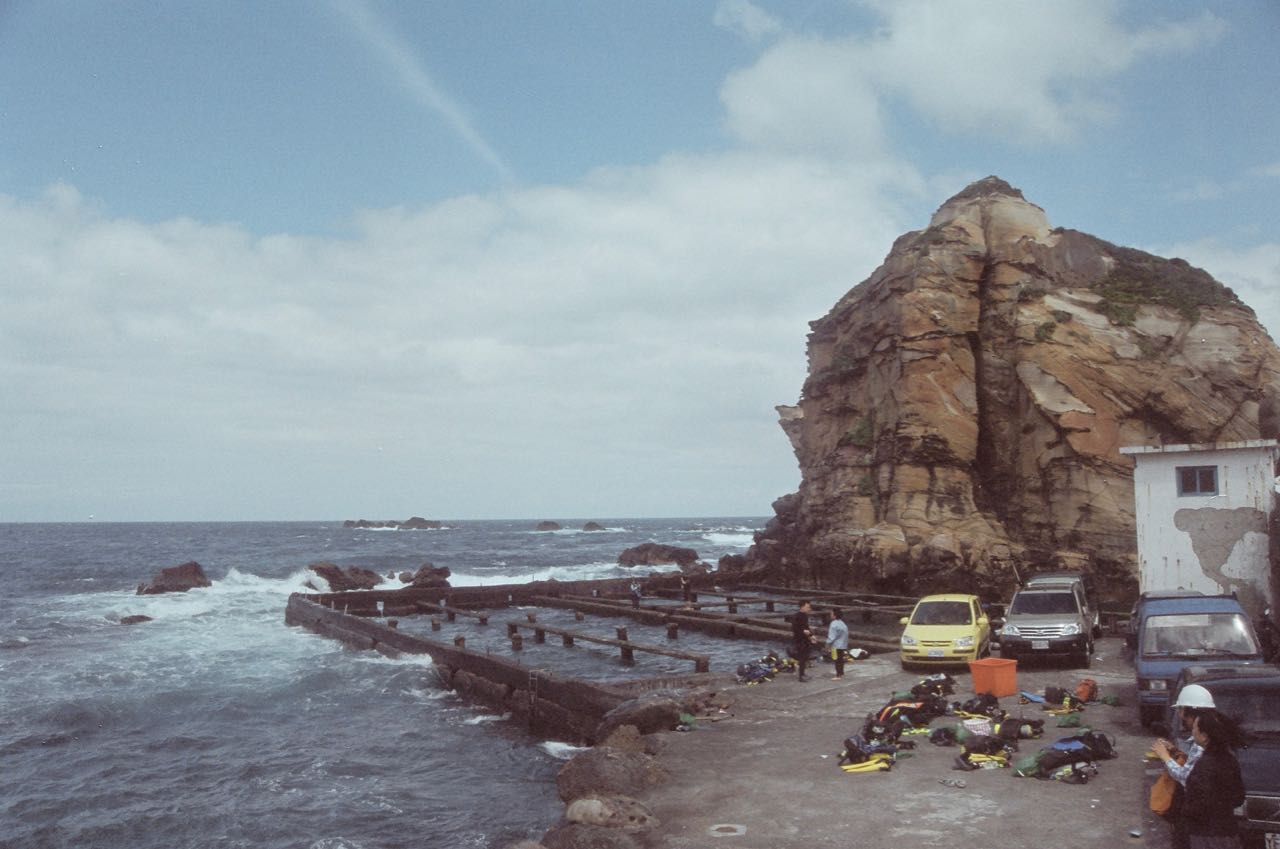
    We started late this day at around 10:00. Weather turned wet and cloudy but there’s not much rain. Leaving Keelung and heading eastwards, there were quite a number of brown road signs showing the directions to some tourist spots. But we did not bother to stop and check. Cycling per se was just too enjoyable.  By 1:00 pm, we had covered 25km and arrived at a cape called Bitoujiao (鼻頭角, literally meaning cape nose tip). Lunch break. John seemed to be doing an experiment of spending his money as frugally as possible. He picked the smallest food stall at the fishing harbour, which served  only bowls of noodles. If you want to reward yourself with some delicious food, there are certainly some seafood restaurants.

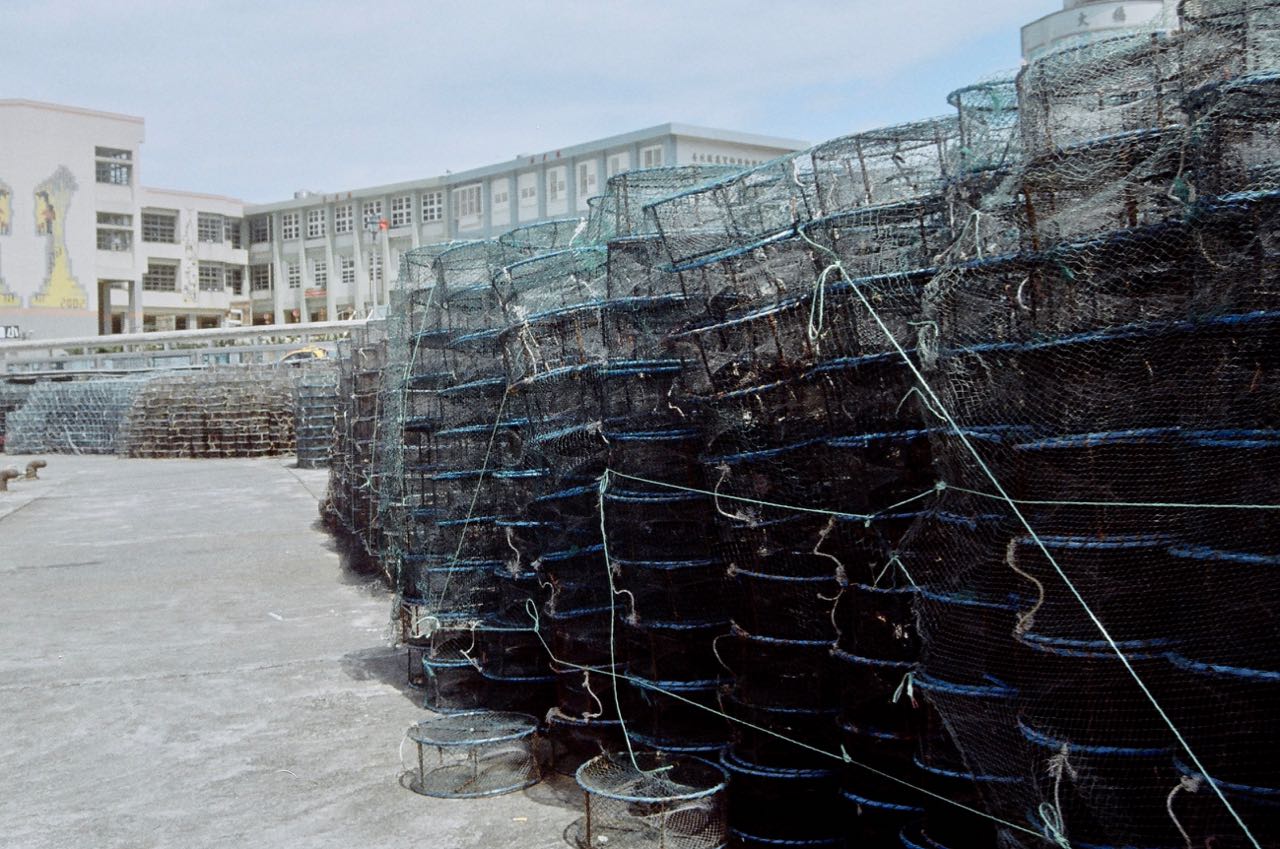
    Little Fishing Harbour on a coast

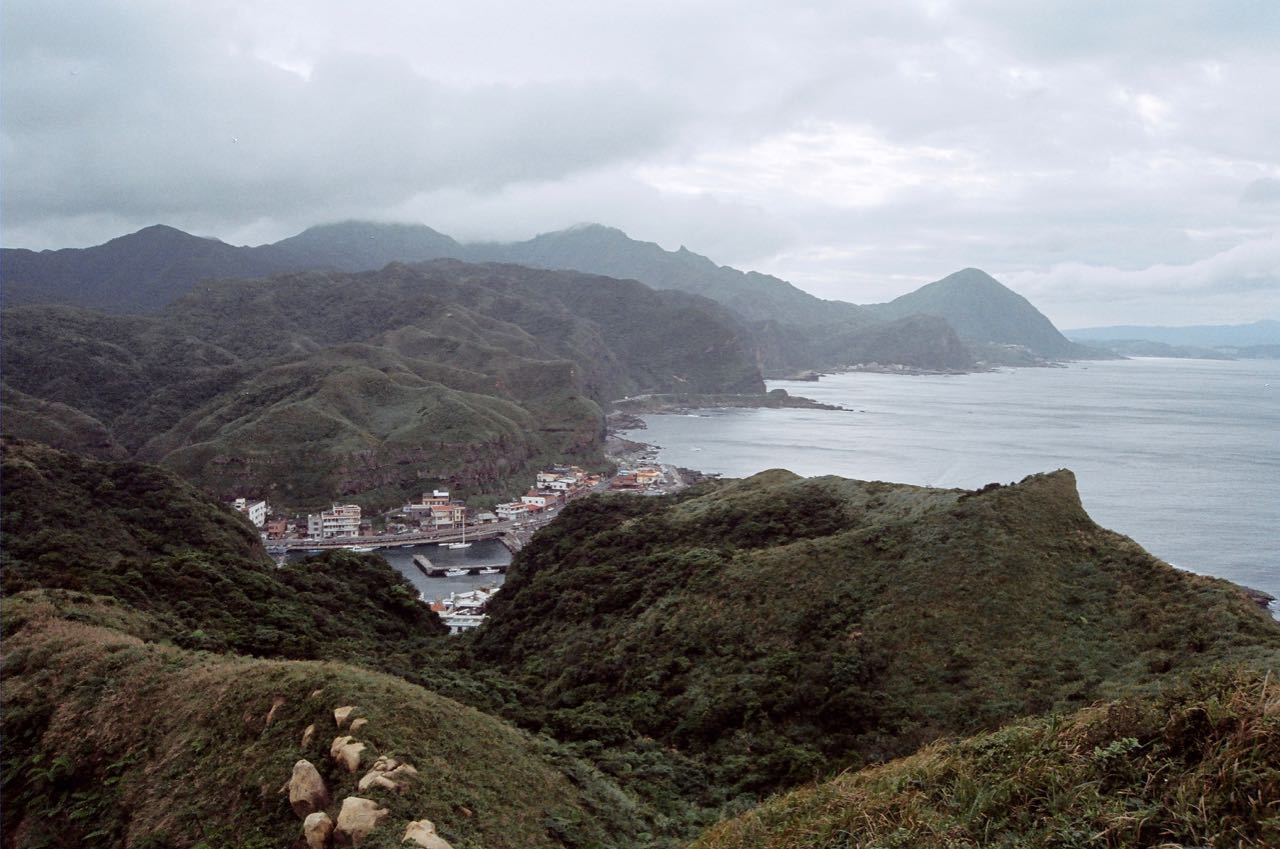
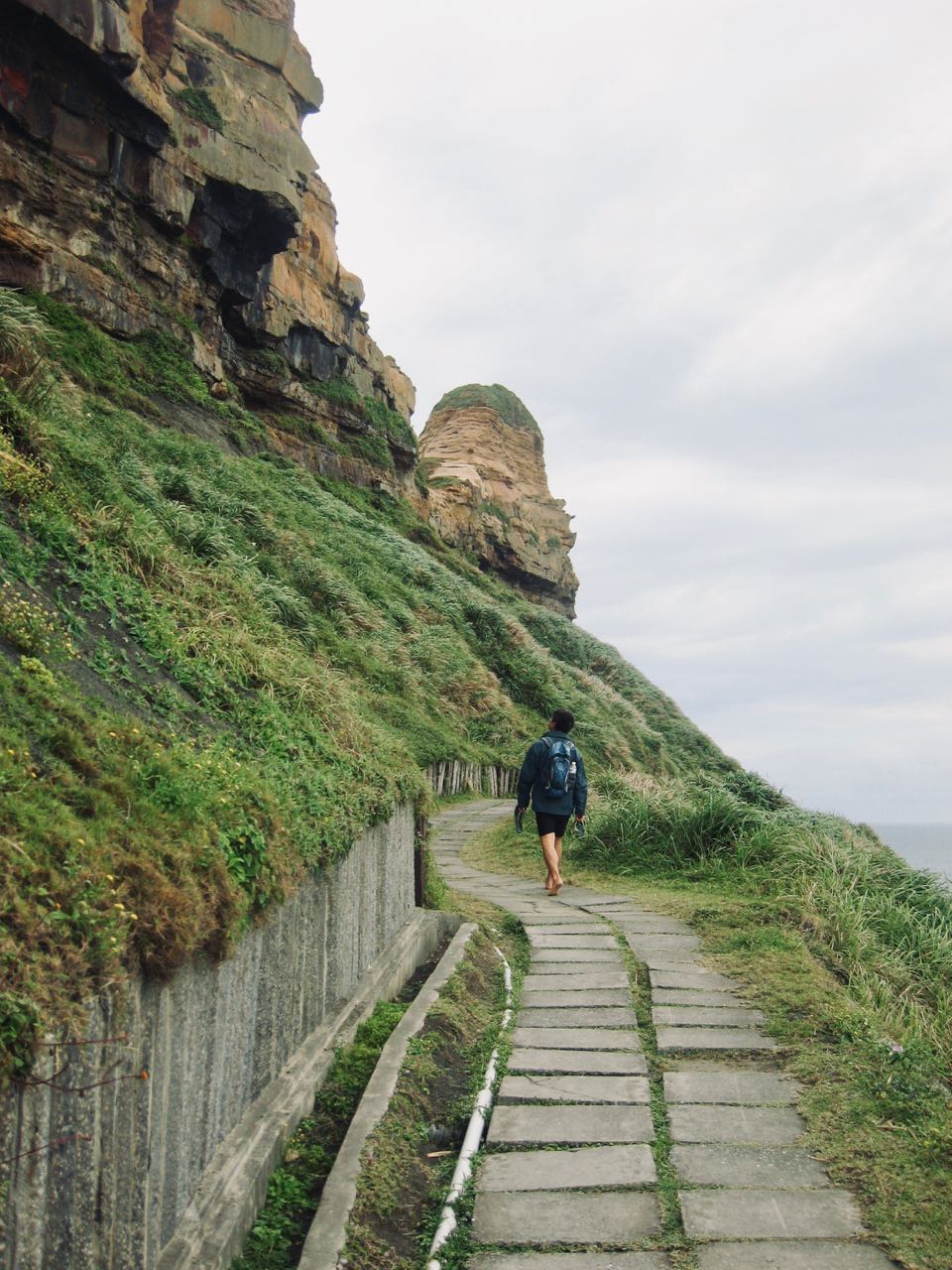
    In spite of our meager lunch there, I had a great time in Bitoujiao. One of Taiwan’s most beautiful primary schools sits on the cape’s cliff with a view of the vast Pacific Ocean in different shades of blue. Like allother public schools in Taiwan, the outdoor area is open to public after school and during weekends. There are three hiking trails in Bitoujiao, all exalted by visitors. We picked the one along the ridge and found a great location where we could look back at the coastal line we had just cycled. Of course I would not miss the trail leading us to the Bitoujiao Lighthouse. (Sadly, this part is closed now because the cliff there has been cracking. Hopefully it will be fixed soon.) Then, we finished the walk with some coffee at the small hut (opens only on Saturday and Sunday) next to the entrance of the primary school. 

    The trails actually form a circuit that links with the fishing harbour. You may leave your bikes at the restaurant and come back in a loop.

    We spent more than 3 hours in Bitoujiao. It was getting dark when we started cycling again. Definitely not a problem; we have done that before. Slowly, we reached Fulong, a small resort village, before 7:00 p.m. The small area right outside the Fulong Train Station is packed with bento (lunchbox) shops. The Rustic Bento (鄉野便當) has been there since 1958. I think I had two of this for dinner. We were not ready to call it a day yet. We were about to reach the easternmost point of Taiwan main island, the Cape Santiago or Sandiaojiao (三貂角). An old train tunnel has been converted to a bikeway and forms a 20 km loop with the route around the peninsula. The Old Caoling Bikeway Loop (舊草嶺環狀線自行車道) was a dedicated bikeway separated from lanes for motor vehicles. With a big beach nearby, this small village does make a good place for families to spend a day or two. The tunnel, which became a short cut through the peninsula to the next village, was closed after 5:00 p.m. No problem at all.  I always have the desire to reach the “extremes” and certainly would not miss the easternmost point of Taiwan.  I would not have used the tunnel even if it were available. The Sandiaojiao lighthouse  is sitting on the peak of Cape Sandiaojiao, casting light onto the sea. We did not go up there as it involved some climbing and it was already too dark. In hindsight, we should have stayed the night at Fulong and visited the lighthouse. Instead, we found a small homestay run by an old lady at the next village, inside a small building with a light-box signage outside. She collected the fees and told us that she would need to go to the temple early the next morning. We could just leave by ourselves. Read: No breakfasts.

  • My First Cycling Trip in Taiwan Day 6

    My First Cycling Trip in Taiwan Day 6

    このブログ記事の翻訳を進行中です。もうすぐ完成しますので、後ほど再度ご確認ください。ご不便をおかけして申し訳ありません。現在は、こちらで提供されているGPXルートや地図などの情報を自由にご利用ください。

    20 April 2009

    We started cycling in drizzles. Without the fenders, soon I had two big vertical stripes on my chest and back, painted by the wet dirts thrown up by the wheels. We reached Toucheng Station (頭城車站) in no time. Some fellow cyclists told us that we could try our lucks here to  board certain trains (without bagging the bikes) to skip the hair-raising Suhua Highway and reach Hualien safely. The next train available was around 4:00 pm. Rain stopped. We headed South (8km) to the hot spring town Jiaoxi to munch on a whole chicken roasted in a kiln fuelled by the wood of litchi or longan. We even had enough time to take a dip in some hot spring before returning to Toucheng Station to board the train.

    In fact, Toucheng Station is no longer an ideal station to board a train with your bikes now. At the time of writing, there are only three trains a day that would carry naked bikes. That one we took has been cancelled. Instead, Luodong station (25km southwards) or Su’aoxin Station (33km southwards) have 9 trains a day, stretching from early morning to around 11:00p.m. You would also skip the most part of Yilan if you board the train at Toucheng as it locates at the northern part of Yilan. Here’s where you can check for relevant information but it’s in Chinese only: TRA Bike Trains. Clients of Bike Express Taiwan need not worry about this; we are happy to check it for you. (Note: The Taiwan Railways Administration has launched their official website on spring of 2019 with the options of Chinese, English, Japanese and Korean)

    Back to my trip. Again, we found ourselves in the dark when we arrived at Hualien and prepared our bikes outside the train station. A woman approached us and tried to persuade us to stay at her hostel. She appeared to be horrified by our idea of cycling in the dark. A man joined in to help. He claimed that he could predict the weather precisely after being a sailor for decades. He sticked one finger into the air and tasted it. “It’s sweet! it’s going to rain soon!”, he concluded and announced loudly. Sorry man! The north and north east coasts had made us experienced cyclists specializing in riding in the rain and in the dark. And please don’t be so sure. It’s very difficult to make predictions, especially about the future! I thought to myself.

    We turned down the woman’s offer and headed into the 180 km longitudinal valley connecting Hualien and Taitung, the Huadong Valley. It was created after the Eurasian Plate and the Philippine Sea Plate kept pushing each other for many many thousand years. It is believed that the Philippine Sea Plate crept above the Eurasian Plate and formed the Hai’an Range or Coastal Mountain Range (海岸山脈). And they are still doing it. That’s why the frequent earthquakes in the area. 

    The valley was more populous than the northern coast. We had a local person cycling with us as he was heading home. He told us that the valley was so full of homestays that we needed not worry about finding a place to stay. Then, we decided to stop for the day after passing several townships at a leisure pace. And nope! Mr. Sailor, there wasn’t a single drop of rain. 

    John, who speaks better mandarin, asked a cashier at a convenient store if there were any homestays around. He came back with a look of disbelief on his face while I was looking for some snacks. Turned out a young lady with a baby in her arm overheard the conversation and invited us to stay in their place, which was just a couple blocks away and where she lived with her husband. For free! Wow! what could I say? I did have a split second of wary thoughts but how could we turn down such a generous offer? If she did not worry about safety issues of having two strangers staying at their place, neither should we. So we accepted her invitation and followed her home. Her husband was a young jade carver. He was appreciating (evaluating?) several pieces of raw jade stones on his desk while we chatted. We were told that Yuli Township (玉里, translated literally as Jade Township) in the valley used to produce a special kind of jade with fibre patterns.

    Even though I could barely participate in the conversation with my broken Mandarin, I gained a new perspective on the Japanese rule in Taiwan (1895 – 1945). I used to think the older generations of Chinese must have all harbored a feeling of hostility towards the Japanese, who had been frequently in war with the Chinese in the past centuries. Being a former wartime foe of KMT and notoriously brutal during World War II, Japan was commonly thought to detest by the older Chinese from the other side of Taiwan strait.I was surprised to learn that some people in Taiwan had a nostalgic view of Japan’s colonial period. Like in all other colonial economies, human and natural resources were used to aid the development of Japan. But firstly, roads, railways, schools, clinics, water supplies, etc. had to be built to facilitate the extraction. After half a century of ruling, the Japanese had left behind numerous valuable infrastructures, historical buildings, sake breweries, sugar mills, logging railways and some intangible assets like agricultural technologies. Of course, the subjects weren’t treated equally. After we moved to Taipei, one of our neighbours told me that Chinese were not allowed to study law and politics during that period. The only prestigious profession left for those Chinese elites to pursue was medicine. This somehow became a convention within the Chinese community and that’s why people in Taiwan are enjoying superior medical services today. The living standard and population had grown significantly when Japan left Taiwan in 1945. Many old Taiwanese have a fondness towards the Japanese. I guess some people in Hong Kong share the same sentiment about the British rule (1841-1941, 1945-1997).

    That was an unforgettable day. 

  • My First Cycling Trip in Taiwan Day 7

    My First Cycling Trip in Taiwan Day 7

    このブログ記事の翻訳を進行中です。もうすぐ完成しますので、後ほど再度ご確認ください。ご不便をおかけして申し訳ありません。現在は、こちらで提供されているGPXルートや地図などの情報を自由にご利用ください。

    21 April 2009

    The next day we did exactly as the hostess told us the night before: leave by ourselves when we woke up. They probably had their own daily routines and did not want to put any time strain on us.

    Some intermittent drizzles again. We continued our tour southwards on the Provincial Highway No. 9 and got a chance to take a good look at the valley in broad day light. Roads were flat and straight and flanked by green paddy fields. It’s a very pleasant view.

    After lunch, we needed to pedal harder. After some serious climbing, I finally reached the top of a slope and stopped in front of a tea shop in the Wuhe village, 210 metres above sea level. As I was waiting for John, who lagged behind me, the tea shop owner waved me in and later offered us lots of tea for tasting. There used to be more than 100 tea farmers with 200 hectares of plantation. In the1990’s, failing to compete with the high mountain (over 1000 metres) tea from the west coast, half of the plantation has gone out of business. 

    Meanwhile in Taitung, inspired by the Oriental Beauty Tea, Chen Huicang (陳惠藏), a specialist of the Tea Research and Extension Station (茶葉改良場, an institute under the Council of Agriculture, Executive Yuan), has developed a special kind of tea that, among other aromas, carries a natural signature flavour of honey.

    Some research findings revealed that, when bitten by tea green leafhoppers, tea plants would secrete some chemicals that, even at an extremely low level, could attract a special kind of spider, Evarcha albaria, which is a predator of the leafhoppers. It seems after hundreds or thousands years of evolution, tea plants has developed a way to call for help. And those chemicals are the sources of that signature flavour.

    A tea farmer from Wuhe village, Gao Zhaoxu (高肇昫), went to consult Chen Huiceng and returned home with the tea processing technique. But he still needed the leafhoppers to bite his plants.

    He adopted the eco-friendly farming practices, including suspending the use of pesticide, as promoted by the government of Hualien Township. After years of development and improvement, the tea produced in Wuhe village has regained its competitive advantage and tea farms started to stand on their own feet again. Until 2007, the total area of tea plantation has returned to 160 hectares.

    Live in harmony with the nature and we will be rewarded with something precious. This is something I learned there.

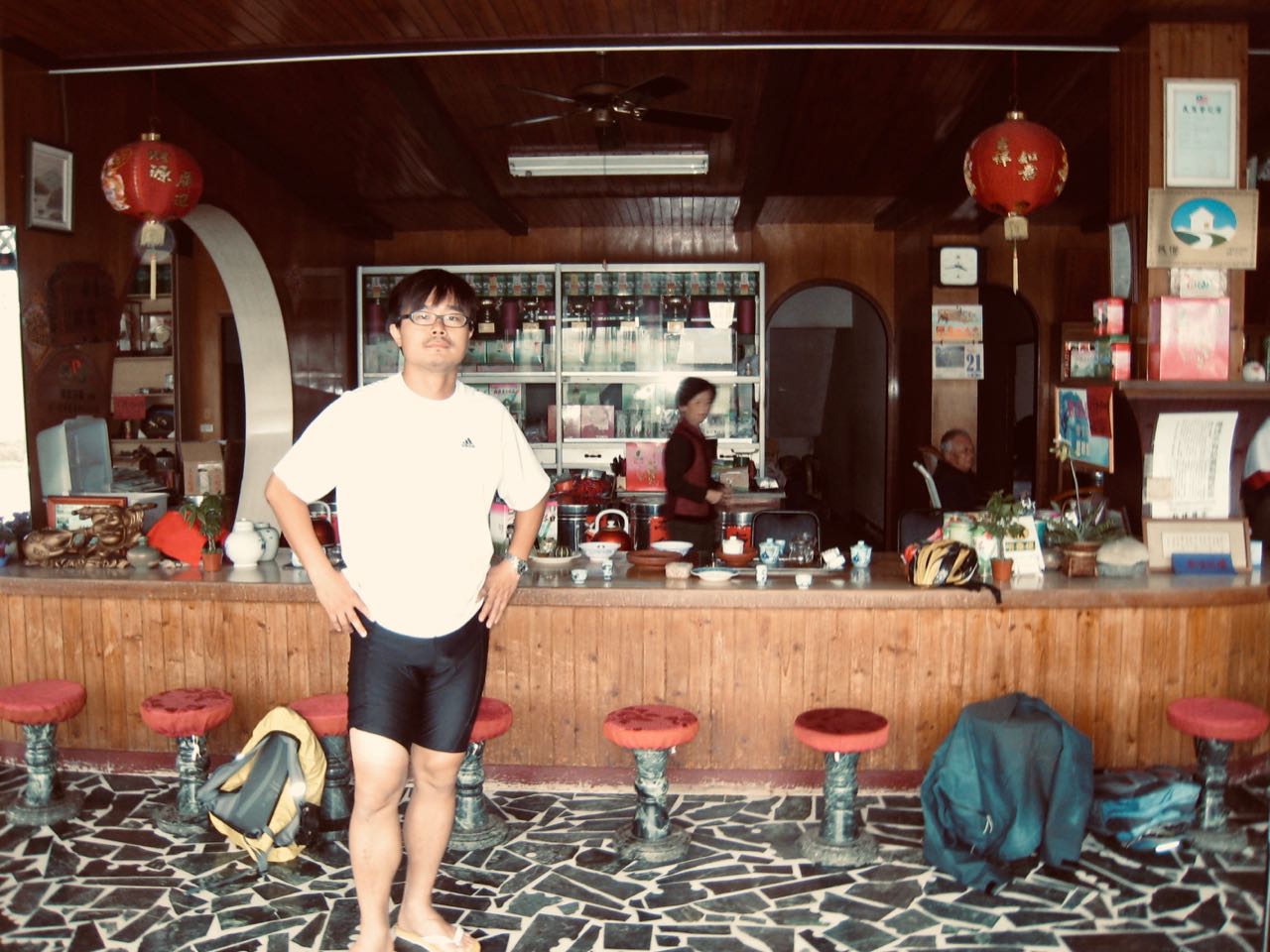
    A cyclist standing in front of a tea shop
    One of the tea shops in Wuhe

    I did like their tea but I could only buy two bags because of the limited space in my saddle bags  and my reluctance to carry too much weight. Actually, if you find something you really want to buy during a cycling trip, you could send it back to Taipei using the railway system. Unfortunately I did not know that at the time.

    We left the tea shop and started descending to Yuli. There were small road signs put up by homestays to advertise themselves. It started raining. We picked one homestay at random and followed the direction on the road sign to to somewhere quite far away from the town centre. It was closed. That sucked, especially after the climb we had to do to reach that homestay. But then even if it’s not closed, we might still end up with a fully booked one. So, you should always call to check before actually committing any time and strength to get there. Homestay owners might not be able to communicate well in English over the phone. Again, the Bike Express Taiwan team is happy to do the job for our clients.

    John used the GPS to find the closest hostel. It must be up and running for some time to have its information stored in the GPS database. We did not have Google Maps back then. Anyway, we could finally take a good rest and wash our soaked cloths.

  • My First Cycling Trip in Taiwan Day 8

    My First Cycling Trip in Taiwan Day 8

    このブログ記事の翻訳を進行中です。もうすぐ完成しますので、後ほど再度ご確認ください。ご不便をおかけして申し訳ありません。現在は、こちらで提供されているGPXルートや地図などの情報を自由にご利用ください。

    22 April 2009

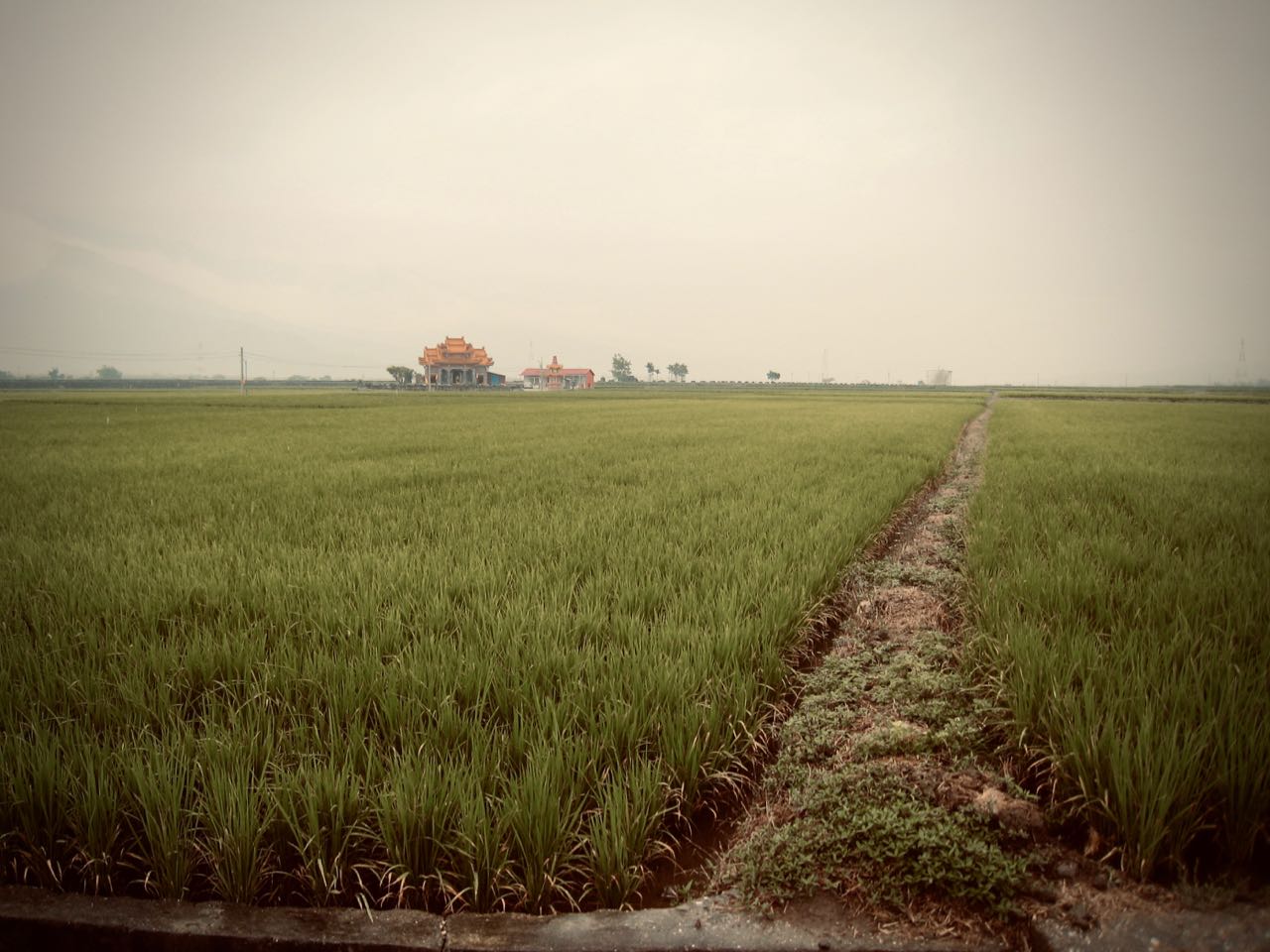
    We continued our trip and headed south along the Provincial Highway No. 9 in the southern part of the rift valley. Before long, we entered Taitung County officially but still needed to ride 50km before we would reach Taitung City. Townships in Taitung County, including Chishang, Guanshan and Luyeh, have been well known for producing the finest rice in Taiwan. There were endless views of paddy fields disappearing into the horizon. 

    The first township to see was Chishang (池上). If you have some knowledge of Chinese, you  would have recognized these two characters on many instances  because several chain stores selling bento (lunchbox) bear the name, eg. , 池上便當, 池上木片便當, 池上飯包. A perfect combination of climate, water, soil and altitude, together with farmers’ meticulous caring of the plants, rice grown in Chishang has been frequent winner in rice competitions. 

    Given that Chishang produces around 12,000 tonnes of rice annually, which is around 1% of Taiwan’s rice production, I wonder if there is enough rice for all those bento shops. Perhaps that’s why the township office is running accreditation programs for bento shops.

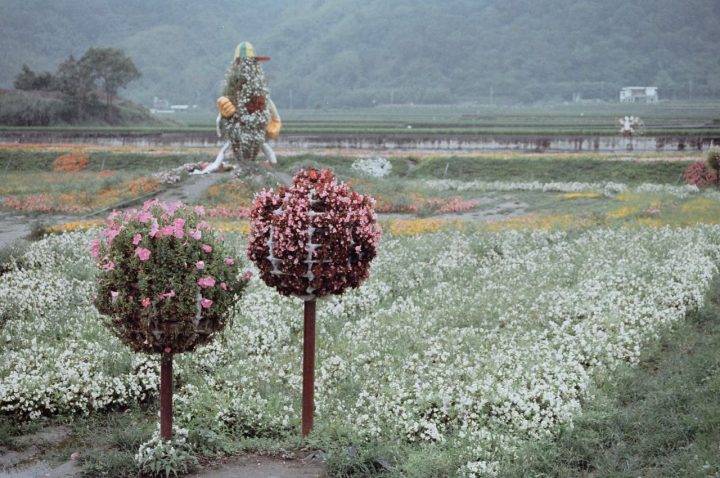
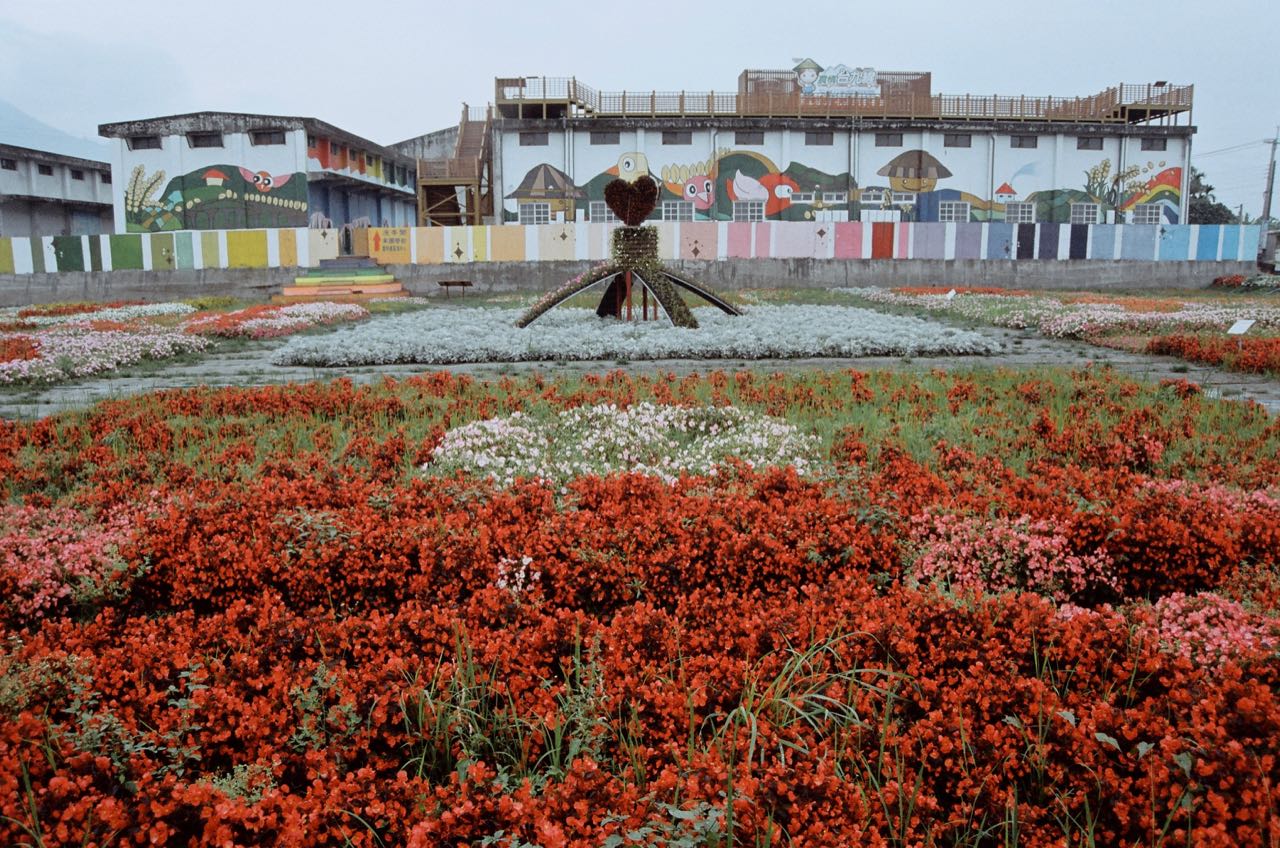
    Then after further travelling for 10 km, we stopped in front of a very colourful building with rice as cartoon characters painted on it’s facade. There was an enormous display of the word Guanshan Rice in Chinese (關山米) on the field, formed by crops of different colours. A platform was set up for visitors to take a bird’s-eye view of the display. The building used to be a rice mill and storage. The Guanshan Township Farmers’ Association had turned it into a tourist service centre. Visitors could sign up for a short demonstration of the process of rice milling. Rice produced in Guanshan used to be a tribute to the Japanese emperor during the Japan rule. But this legacy alone was not enough to ensure their products thrive in the market. We could tell that the Farmers’ Association had put in lots of efforts to polish their brand.

    We missed two famous tourist spots around Chishang because we did not know of them at the time: the Dapochi and the Brown Boulevard. They are definitely worth the trouble of taking a detour. It’s pretty easy when you have Google Maps. Just set the Destination to “Dapochi” when you are approaching Chishang Station. After you have enough fun there, use Google Maps again to guide you to “Brown Boulevard”. If you are travelling northwards, set your destination  to “Brown boulevard” when you are leaving Guanshan Township.

    We climbed a little bit to Luyeh Highland and then started a 20 km nice long descend from 240 metres to 40 metres above sea level towards Taitung City. It was awesome. We were moving like the wind. 

    And that’s it. It’s about the end of our trip. We found a random hotel to stay for the night and did some common tourist thing. The next day, we cycled to Taitung Train Station and shipped the bicycles to Songshang Station in Taipei. This simply is a wonderful service for cyclists like us who prefer travelling without a rigid plan. There are more than 50 stations scattered on the island with luggage rooms that allow you to drop off your bikes. Because of this, we can plan our routes with a lot more flexibilities. We can even send some personal belongs or souvenir we bought along the way to the next stop or the final destination in order to slim our saddle bags.

    Parted with our bikes, we completed the around-the-island tour by taking a train from Taitung to Kaohsiung and then the High Speed Rail to Taipei. We did some sightseeing in Kaohsiung and Taipei but it was kind of weird (cold turkey?) to switch from pedaling to bipedalism. I missed the bike, the mobility and freedom it brought me, and the encouraging smiles from strangers when I was breezing past their sides. 

    — End —

  • A Bike-Day Trip in Taipei City by Pirawadee

    A Bike-Day Trip in Taipei City by Pirawadee

    このブログ記事は英語のみで提供されています。ご迷惑をおかけして申し訳ありません。

    Guest Contribution from Pirawadee of Radtour

    เรามีทริปไทเปสี่วัน โดยวันสุดท้ายเป็นฟรีโปรแกรม เมื่อรู้ดังนั้น แผนการของสายปั่นจึงเกิดขึ้น

    ฉันติดต่อที่เช่าจักรยานในไทเป ซึ่งเสิร์ชพบว่ามีหลายที่ หลังจากศึกษาข้อมูลต่างๆแล้วก็ตกลงปลงใจกับ Bike Express Taiwan เลือกรุ่นและขนาดของจักรยาน จ่ายเงินออนไลน์ แล้วก็บอกให้มาส่งที่โรงแรมตอน 8:30 น.ของวันจันทร์ที่ 11 มีนาคม หลังจากนั้นก็กำหนดเส้นทางการปั่น และเนื่องจากสมาชิกปั่นจำนวน 8 คนในครั้งนี้ มีครึ่งหนึ่งที่นอกจากปั่นรอบสวนรถไฟแล้วก็ยังไม่เคยปั่นท่องเที่ยวที่ไหน ดังนั้น route ของเราจึงต้องไม่โหดมากนัก ระยะทางรวมทั้งสิ้นตลอดวันประมาณ 15–20 กม.เท่านั้น

    ระหว่างนั้นก็เช็คสภาพอากาศ ลุ้นจนคืนสุดท้าย เพราะตลอดทริปฝนตกทุกวันมาหยุดเอาคืนก่อนวันที่ปั่นนี่เอง มากับดวงจริงๆ

    Since we would have a free day on the last day of the company outing, we decided to take a short bike trip in Taipei city. Have been searching for some info, I ended up using the bike rental service with Bike Express Taiwan. The appointment is on March 11th, 8:30 am at the hotel and they would pickup the bikes at 6 pm. There were 8 of us and half have never been in the bike trip before. So what I have planned would be quite easy with total distance of around 15–20 km. for the entire route.

    Our fate then relied on the weather. There had been raining everyday since the beginning of the trip. Luckily, there was no rain on our day.

    The bikes we used were Rikulau Audax Hecules with variety of sizing. After signing the contract and paid the deposit, we then started our trip.

    8 นาฬิกาตรง ร้านจักรยานทยอยขนรถมาเรียงไว้หน้าโรงแรม จักรยานที่เราใช้วันนี้เป็นยี่ห้อ Rikulau รุ่น Audax Hercules แบบแฮนด์ตรง มีตั้งแต่ขนาด XXS, XS, S, และ M ตามมาตรฐานความสูงชายหญิงไทย พอ 8:30 ปุ๊บ Lois เจ้าของรถเช่าก็มาถึงพร้อม accessories ต่างๆ ฉันเซ็นสัญญา จ่ายมัดจำข้าวของ หลังจากสมาชิกทดลองขยับกันเรียบร้อยเราก็พร้อมลุย

    การปั่นจักรยานในนครไทเปง่ายมากๆ เพราะทำเหมือนคนเดินถนน แค่เปลี่ยนจากสองขาเป็นสองล้อ ปั่นไปบนฟุตปาธ ซึ่งจะมีเลนจักรยาน หากถนนไหนไม่มีเลนจักรยานเฉพาะก็ใช้ร่วมกับคนเดิน โดยกฎหมายจะให้สิทธิคนเดินก่อน “Pedestrian has right of way” เวลาจะข้ามถนนก็ข้ามตรงทางม้าลายตามจังหวะสัญญาณไฟ และอย่าลืมว่า ไทเปขับรถชิดขวา ดังนั้นเวลาเราปั่นในเลนก็ต้องปั่นชิดขวาเช่นกัน เพราะอาจมีจักรยานปั่นสวนทางมาได้

    Cycling in Taipei is very easy. We cycle on the footpath which normally have a bike lane. If there is no specific bike lane on the footpath then bicycles will share the path with the pedestrian. Wait for the green signal when crossing the road and remember that in Taipei, drive rule is on right hand side.

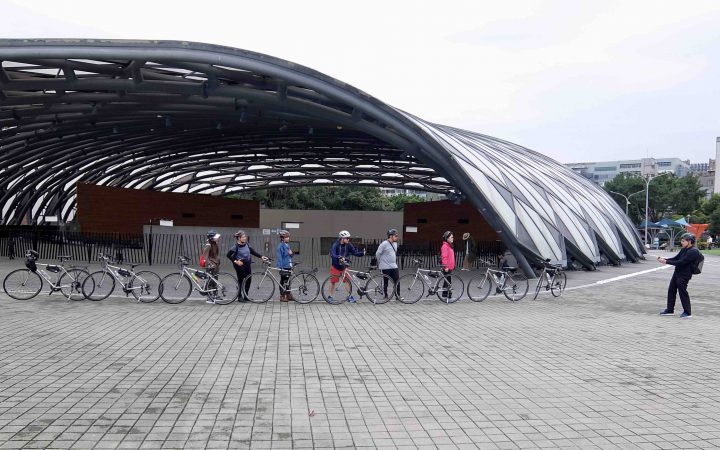
    จุดแรกของเราคือไป Taipei Expo Park ซึ่งเคยใช้เป็นที่จัดงาน Taipei International Flora Exposition ในปี 2010–2011 มาก่อน แม้ว่าจะนานมากแล้วแต่สภาพพื้นที่ยังสวยและดูดีอยู่มาก ไฮไลท์ของสวนนี้อยู่ที่ Expo Dome ที่เป็นเวทีแสดงงาน สถาปนิกวิศวกรอย่างเราจึงกิ๊วก๊าวกับรูปลักษณ์ของโดมกันพอสมควร

    ในสวนแห่งนี้ มีพื้นที่ที่น่าสนใจและสวยงามอยู่หลายจุด เช่น อุโมงค์ต้นไม้ (แม้ว่าวันนี้ จะแห้งแล้งไปบ้าง) และพาวิลเลี่ยนต่างๆ รวมไปถึงสะพานพลังงานแสงอาทิตย์ (Solar Bridge) ซึ่งขนาดว่าวันนี้ไม่มีแดดเลยยังสามารถผลิตพลังงานไฟฟ้าได้จำนวนไม่น้อย

    Street Furniture และ ป้ายสัญญลักษณ์ต่างๆ เป็นศิลปะที่สวยงามน่าสนใจ

    There are several interesting areas in the park. Floral tunnel and the solar bridge are ones among them. All street furniture, graphic and signage are of interested items too.

    There are 40 solar panel on the bridge roof.
    เราปั่นผ่าน Fine Art Park มาออกมุมบนสุดของสวนส่วนที่ติดกับ Minzu Park เพื่อไปจุดหมายที่สองคือบ้านโบราณที่ชื่อว่า Lin An Tai Ancestral House เสียดายที่ลืมเช็คมาก่อนว่าเขาปิดวันจันทร์ เราเลยได้แต่ถ่ายรูปด้านหน้ากับส่องๆดูเท่านั้น

    Second destination was the Lin An Tai Ancestral House. But unfortunately, is is closed on Monday so we could only look from outside.

    Lin An Tai Ancestral House
    ใกล้เที่ยงแล้ว เราตั้งใจไปกินกลางวันกันที่ตลาดปลา Addiction Aquatic Development (บางคนในทีมถูกหลอกล่อให้มาปั่นเพียงเพราะบอกว่าจะพาไปกินอาหารทะเลที่นี่ อิอิ) ใครไม่เคยมาไทเป ขอแนะนำให้มากินอาหารทะเลที่นี่สักครั้งหนึ่ง ราคาถูกและสดมาก รับเงินสดเท่านั้นนะคะ นอกจากอาหารทะเลแล้วก็มีอาหารอื่นๆด้วย มีทั้งแบบเลือกมาสดๆแล้วให้นำไปปรุง หรือจะเลือกที่ปรุงสำเร็จแล้วก็ได้

    ด้านหลังของพื้นที่กินนี้ เป็นตลาดปลาจริงๆคือ Taipei Fish Market แต่เรายังไม่เคยเข้าไปดู

    Addiction Aquatic Development is a place where we had lunch. If you spend time in Taipei, this is a place of recommendation. The food is really good, fresh and reasonable price, especially all seafood. Behind the development is the Taipei Fish Market.

    อิ่มแล้วก็ปั่นต่อ ไปหาที่กินกาแฟกับขนมกัน ย่านถนน Fujin Street แหล่งฮิปสเตอร์คือเป้าหมายถัดไป อาจเป็นเพราะวันจันทร์ คนก็เลยค่อนข้างน้อย หลายๆร้านก็หยุดวันนี้ด้วย

    หาร้านกาแฟอยู่เป็นนาน ไม่มีเปิดเลย ฉันไปเก้ๆกังๆอยู่หน้าร้าน “หมูน้อย” ที่ดูเมนูเป็นร้านขายอาหาร จนเจ้าของร้านออกมายิ้มพร้อมกับเชิญชวนให้เข้าไปกิน ฉันถามว่ามีกาแฟขายมั้ย เขาตอบว่า มีสิ ดีด้วยนะ นอกจากกาแฟยังมีขนมอร่อยด้วย เขายิ้มกว้างพร้อมถามว่า กี่คน

    เรานั่งกินกาแฟที่ดีจริงอย่างที่เขาว่ากับขนม ก่อนจะจากลาไปปั่นต่อ

    After lunch we went to “Fujin Street”; the famous area for hipster. It might be because of Monday so there was very few people around thus less shops openned.

    We spent an hour enjoying our coffee and dessert at Au Petit Cochon: The Little Pig cafe. They serve good coffee though.

    ช่วงบ่ายเราวางแผนไปปั่นริมน้ำกัน

    จาก Fujin Street ปั่นตรงไปเรื่อยๆมุ่งหน้าริมแม่น้ำ ปั่นบนฟุตปาธเลาะกำแพงไปจนถึงทางเข้าสวนใต้ Minquan Bridge พอปั่นเข้าไปด้านหลังกำแพงเท่านั้น ทุกคนถึงกับร้องว้าว รีบจอดรถลงไปถ่ายรูปกันใหญ่

    ทุ่งหญ้าเขียวขจีมีดอกหญ้าสีขาวเล็กๆแซมกระจายไปทั่ว บนเนินขนาดใหญ่มองลงไปเห็นแม่น้ำ Keelung และสะพาน สองสามแห่งขนานกันไปสวยงามเกินบรรยาย

    พื้นที่สวนริมน้ำนี้ มีทางเดินและทางปั่นจักรยานเลียบไปโดยตลอด สภาพสวนสวยงามมาก ดอกไม้บานสลับสีสดใส ส่วนด้านกำแพงก็มีเรื่องราว กระทั่งงานกราฟฟิติ้ก็ยังดูน่าสนใจ

    เราปั่นจนไปถึงทางออกใต้สะพานสายรุ้ง

    From Fujin Street, we rode in the direction toward the river. Enter the riverside park via the entrance under the Minquan Bridge just to see the large lush mound with white tiny flower scattered around, down below is the Keelung river.

    The area along the river side is mixed with pavement, colorful flower garden and street art. We rode along this area until the exit under the Rainbow Bridge.

    จุดสุดท้ายเราไปแวะที่อนุสรณ์สถานของดร. ซุนยัดเซ็น Sun Yat Sen Memorial Hall ซึ่งใกล้กับช่วงเวลาที่เขามีการเปลี่ยนทหารรักษาการณ์กันพอดี ก็เลยได้ดูอีกรอบ ที่นี่ไม่ต้องเบียดคนมาก แต่ที่น่าสนใจคือนิทรรศการภาพวาดที่กำลังจัดแสดงอยู่ ชื่องาน Female Elegant Demeanor — Woman Figure Watercolor Painting Exhibition เป็นภาพวาดสีน้ำภาพเหมือนคน ที่เหมือนมากๆ ขนาดถ่ายรูปแบบซูมยังเหมือนคนจริงๆเลย

    เราออกมาจาก Memorial Hall กันตอน 17:30 แล้วปั่นกลับโรงแรมทันเวลานัดหมายส่งรถพอดี

    เป็นทริปปั่นที่สนุกและน่าจดจำอีกทริปหนึ่งทีเดียว

    The last stop was Dr. Sun Yat Sen Memorail Hall. We went there by the time they changed the guard so we had an opportunity to see the event with less crowd. One exhibition in the Bo-ai Gallery is “Female Elegant Demeanor — Woman Figure Watercolor Painting Exhibition” which is really impressed for realiness of the painting.

    We left the memorial hall around 5:30 pm and arrived on time of the pickup at 6 as scheduled.

    It was such one of a great bike trip we had so far.

    Thank you Lois from Bike Express Taiwan for your great service.

    Continue to read Pirawadee’s other articles on Medium

  • Product Review: Touring with a Klever B Comfort E-Bike – A Long Coastal Route Test

    Product Review: Touring with a Klever B Comfort E-Bike – A Long Coastal Route Test

    このブログ記事の翻訳を進行中です。もうすぐ完成しますので、後ほど再度ご確認ください。ご不便をおかけして申し訳ありません。現在は、こちらで提供されているGPXルートや地図などの情報を自由にご利用ください。

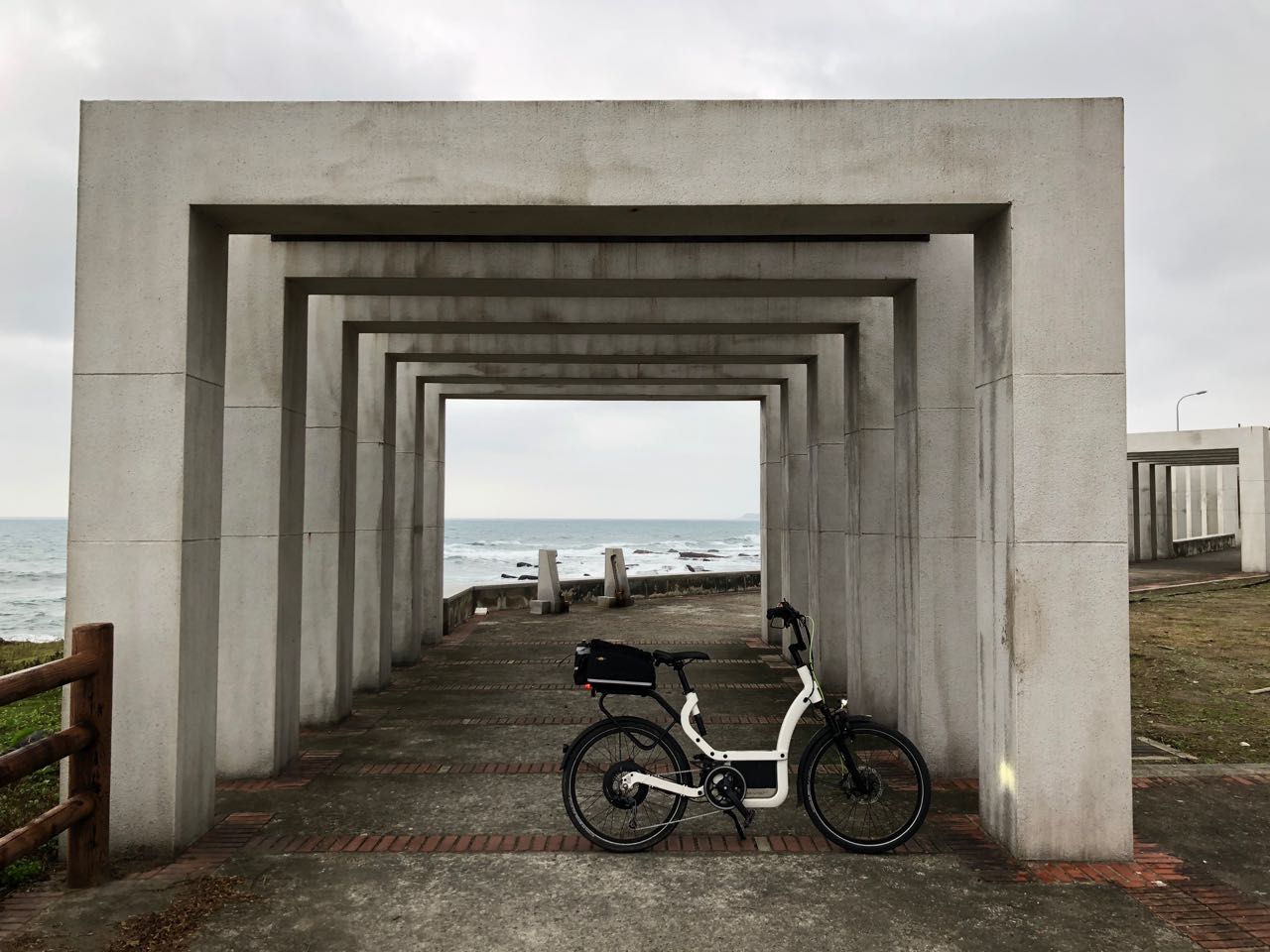
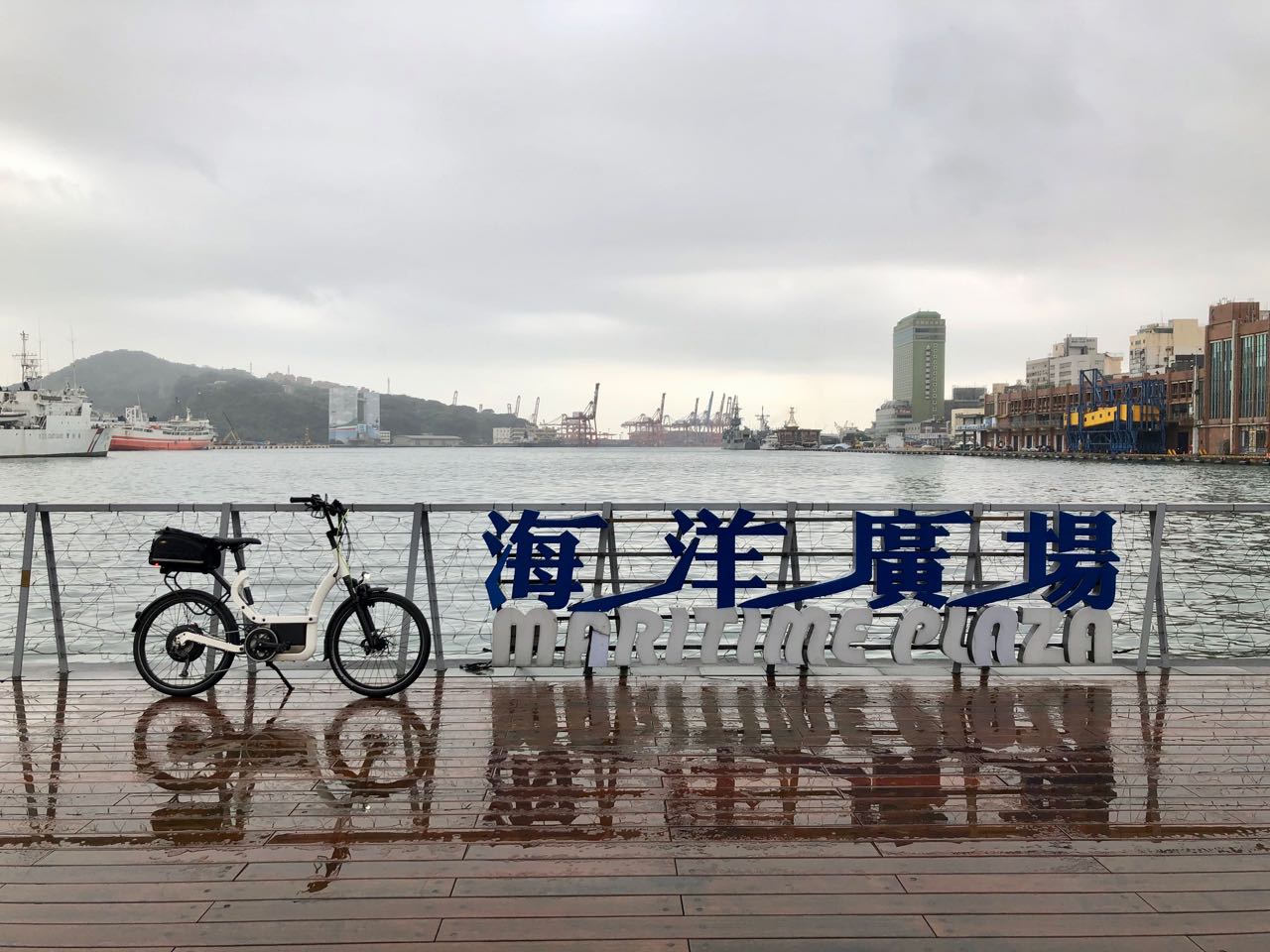
    My second test with this E-bike was a longer trip with less climbing. I cycled to Keelung from Dahu Park because I was quite sure I could not board the train with the e-bike. From there, I travelled along the northern coast mostly on the Provincial Highway 2 to Tamsui, then headed home along the Riverside Bikeways. It was a 118km route, which felt mostly flat to me. But turned out the accumulated gain on elevation on those mild slopes added up to over 1,232 metres, according to my Strava record. 

    It was a cloudy day with occasional drizzles. Braking on the wet road was effective with the 2.15” tyre and the hydraulic disc brake. And luckily my pants and bags were well protected by the fenders of the two wheels. Without them, the dirt and the filthy water threw up by the rear wheel could have accumulated on my lower back and found their way to my under pants. Well, I don’t really mind cycling in the rain and got soaked – all my bikes do not have fenders. But for some reason, when I am riding an e-bike, I expect a certain level of comfort. 

    I made it to Keelung in under one hour. I could reach 25km/h easily in the head wind or when climbing a mild slope. This was amazing! One would probably need to spend the same amount of time with public transportation. 

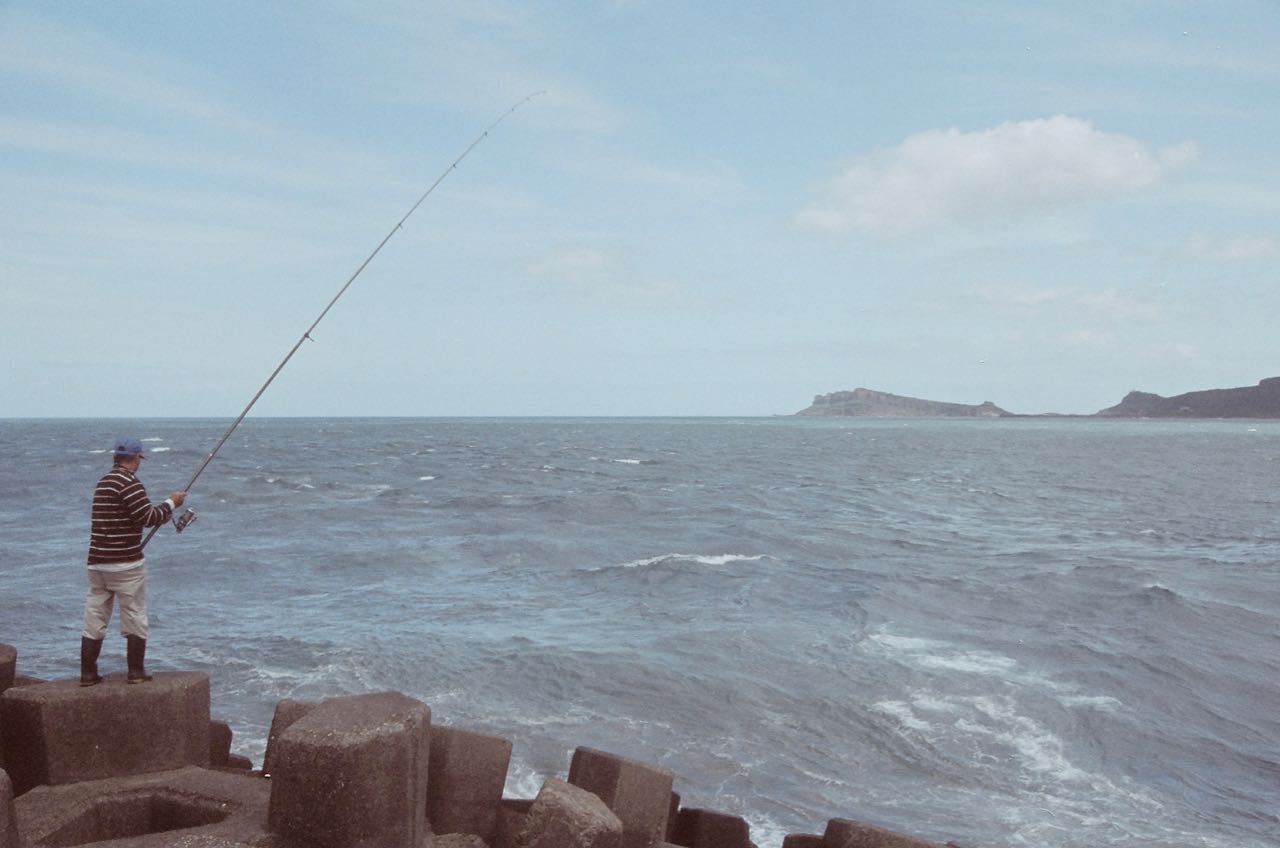
    I left the main traffic and avoided a major climb by heading straight to Waimushan Fishing Harbour. Rain stopped there. I started my coastal cruise, passing through Wanli Fishing Harbour, Yehliu Geopark, Jinshan Old Street. I made it to Fuguijiao Lighthouse (65km of the 118km trip) after traveling for 5 hours with lots of short pauses in between to take pictures and a longer one for lunch. Then the battery was almost exhausted at 70km. I swapped in the fresh one and arrived at Tamsui Old Street in an hour. It was still early, around two o’clock. But I needed to be home for a shower and have dinner with the kids. Strong headwind at the Riverside Bikeways. No worries! My second battery was still fresh. We pierced into the wind with ease. The only problem was that my bottom started to hurt after sitting on the saddle for 7 hours. Again, when I was home, the second battery was still half full. 
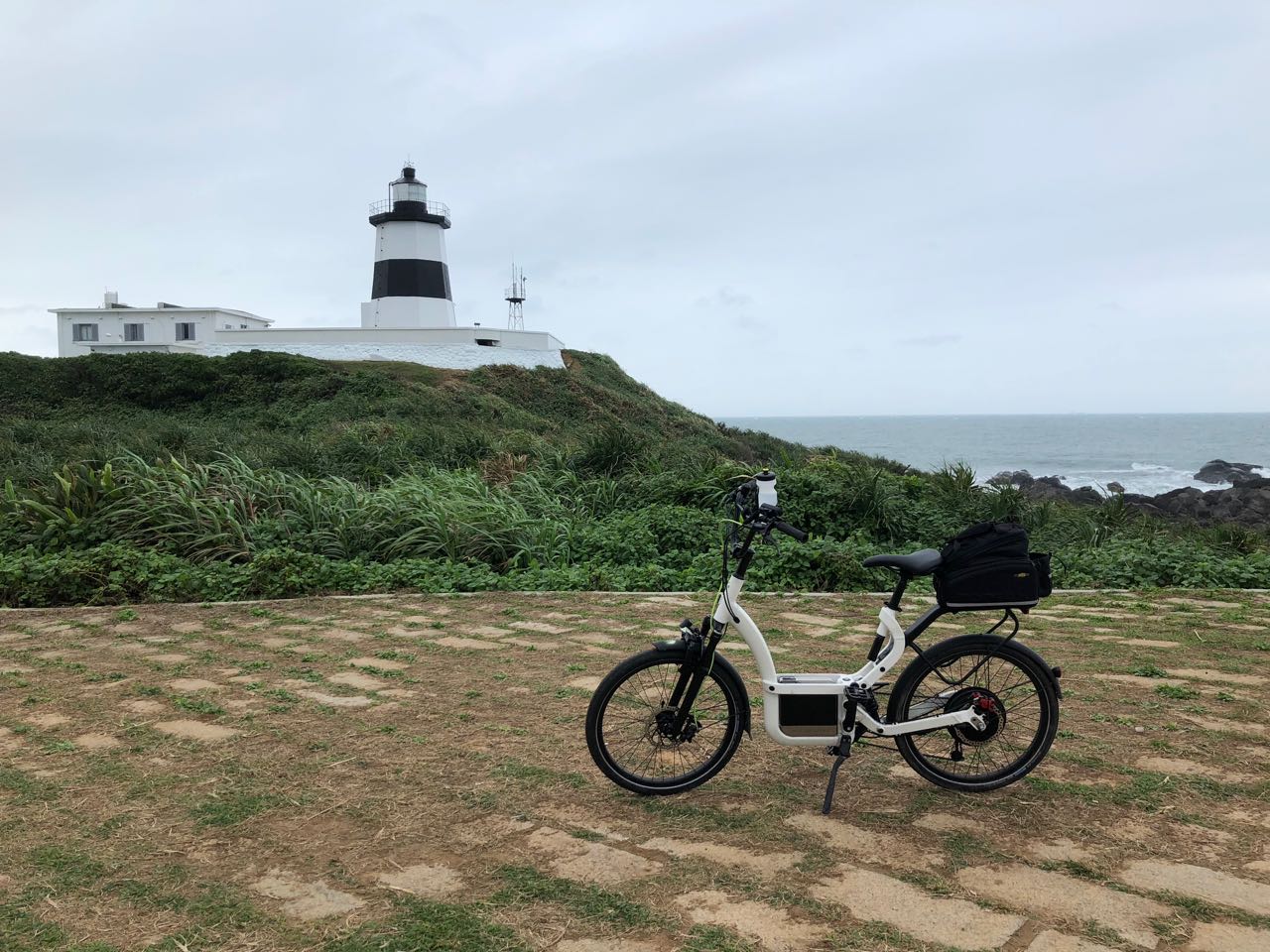
    This is my route on my Strava record.

    https://www.strava.com/activities/2001072404

    Conclusion:

    The Klever B Power is a great e-bike for bike-touring. It can handle hilly roads and travel long distance, rain or shine. Consistently sensing my pedaling, the motor offers me help accordingly without me having to ask (or push buttons).  

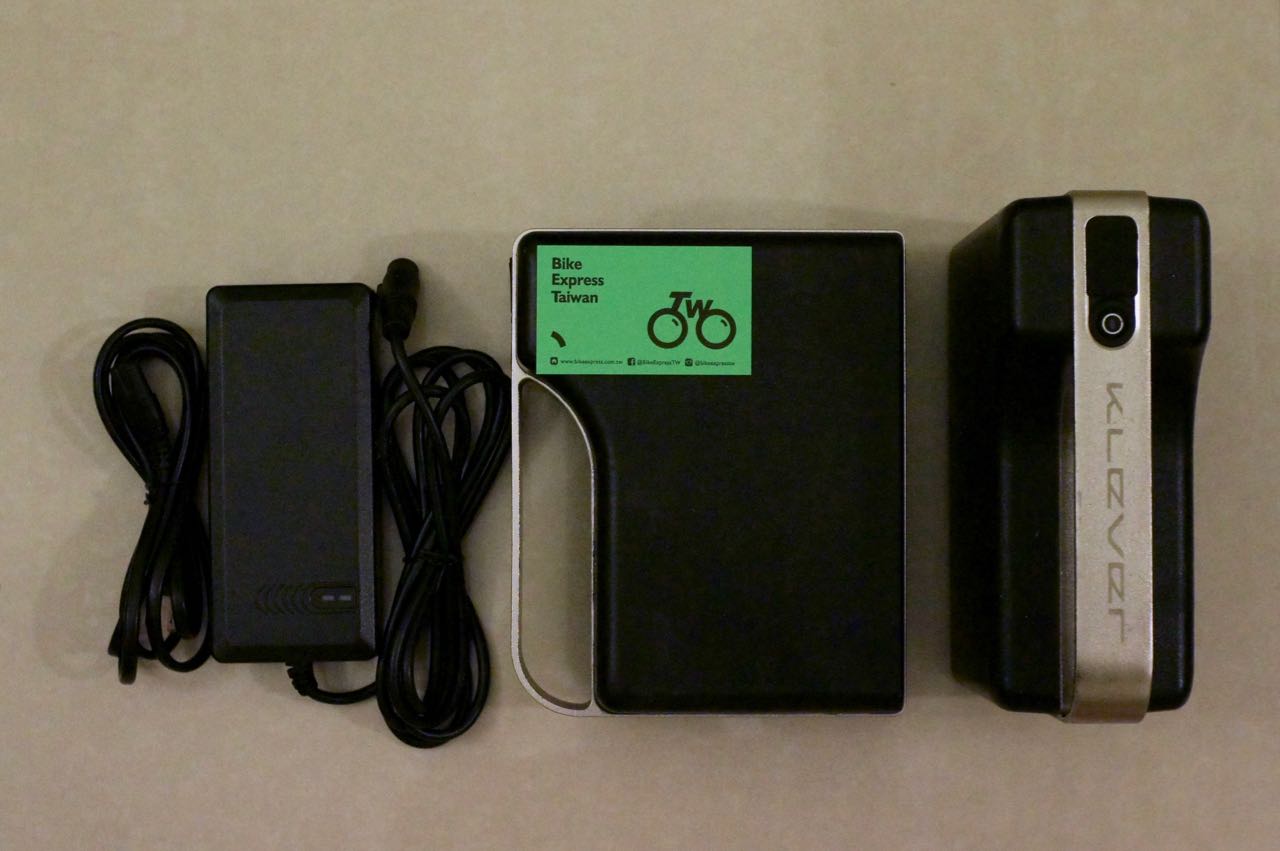
    According to my two test rides, you will need a spare battery for day-long trips or multi-day bike touring. The traveling charger can refill an empty battery in 5 hours. Assuming you haven’t exhausted both batteries, which may not be wise, you can recharge the half-empty one first when you settle for the evening, and then plug in the empty one overnight. 

    Without the help from a gearing system, a hub motor has to drive the wheels directly and may get overheat when the slopes are too steep to climb. My friend from Klever told me that their BIACTRON system would protect the motor by cutting off the power when it becomes overheat. When it cools down, it works again.

    A mid-drive e-bike is less likely to suffer from overheating, because it enjoys the benefits of its internal gears and the bike’s gearing system. However, the bike’s drive system is operating under greater stress because it pulls the chain together with the rider’s force. The cassette and chain set got worn out more quickly. And worse, the chain could snap on the way. 

    In the case of a rear hub motor, when it works, it removes some tension from the chain by driving the wheel directly. 

    Anyway, I am looking to try a mid-drive e-bike someday to do a comprehensive evaluation and a first-hand comparison of the two systems. Meanwhile, check this out for a thorough comparison of the two systems.

    So, now we have got e-bikes suitable for bike-touring, is Taiwan a suitable place for bike-touring with e-bikes? Absolutely! Taiwan government has been building roads with slow vehicles, i.e. scooters and bicycles, in mind. One can always find designated lanes for slow vehicles on busy roads, bridges and tunnels. E-bike riders can also use the bikeways along the rivers that are commonly found in most cities and townships. The population density in Taiwan is just about right that you can find a hotel, hostel or homestay to stay each night and recharge your batteries with little difficulty. And according to our own experience, you hosts can usually find you a safe place to store your bikes.
    More Readings: https://www.cyclingabout.com/bicycle-touring-on-electric-bikes-ebikes/

  • Product Review: Touring with a Klever B Comfort E-bike – A Hilly Route Test

    Product Review: Touring with a Klever B Comfort E-bike – A Hilly Route Test

    このブログ記事の翻訳を進行中です。もうすぐ完成しますので、後ほど再度ご確認ください。ご不便をおかけして申し訳ありません。現在は、こちらで提供されているGPXルートや地図などの情報を自由にご利用ください。

    We have been receiving enquiries about e-bikes for hire from time to time. So we asked around and were introduced to an e-bike manufacturer, Klever Mobility, who generously loaned us an e-bike for a try.

    An e-bike, or a so-called pedelec (from pedal electric cycle), can be compared to smartphones in its infancy. There used to be palmtop computer makers who tried to add the functions of a telephone to their PCs, and mobile phone makers who tried to make their phones run computer applications. This is what’s happening in the motorbike and bike manufacturing industries. Klever Mobility is a daughter company of Kymco, a well-established local manufacturer of scooters and motorcycles with more than 50 years’ experience, who has also been working on electric mobilities for more than 20 years. Founded in 2011 and carrying with it years of invaluable experience in building machine-powered bikes, Klever Mobility commits itself to designing and building the hybrid that can unlock the full potential of electric mobility and offer the best riding experience.

    In terms of motor positioning, there are two major types of e-bikes at the moment: hub-drive and e-drive. Hub motors, which place the electric motor in the center of a bicycle wheel, are certainly the most common form of electric bicycle motors.

    Mid-drive motors, which house the motor closer to the center of the bicycle and transfer the motor’s power to the rear wheel via the bicycle’s chain drive, have become much more common over the last 2-3 years, and are cutting significantly into the hub motor’s lead as the king of the e-bike motors. (1).

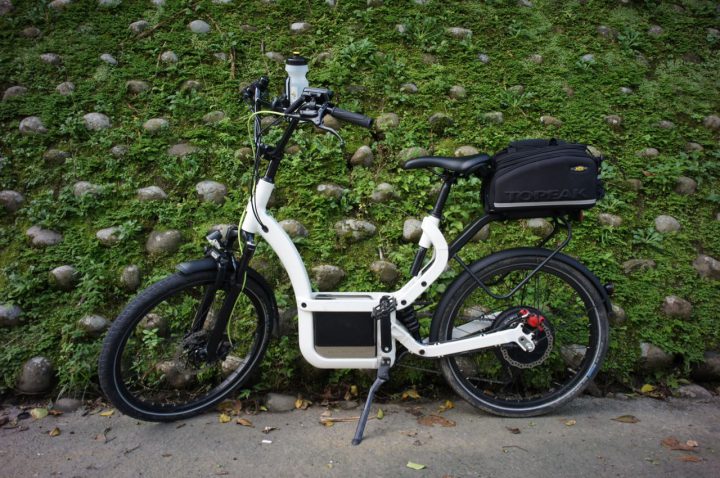
    The Klever e-bike loaned to us is a member of the low step-through and full suspension B series, belonging to the hub-drive family. It comes with an in-house developed rear drive system called BIACTRON, which consists of a 350W gearless and brushless rear hub motor with torque sensors, capable of regenerative coasting and braking. The 470Wh battery is rectangular in shape, which makes it easy to be packed in most touring bags. When in use, it will be put inside a slot in front of the bottom bracket. It helps to keep the centre of gravity low. 

    As to the non-electrical, human-powered system, it has a 48-tooth chainring and a set of Shimano Deore 10-speed cassette (11-32 Teeth). One may take note when doing the maths on the gear ratio that the size of the wheels are 24 inches. A standard mountain bike comes with 26 inches wheels. 

    When everything is fixed to the newly designed robust aluminum frame, must say it looks more like a scooter than a bike – it may not be a surprise when we consider its lineage. I had been quite skeptical about the effectiveness of the pedals of e-bikes, after seeing enough e-bike riders on the streets using their pedals as mere footrests. So, to see whether my skepticism is legitimate, I started the test ride without a battery. Turned out it ran very smoothly. The motor did not get in the way of my pedalling; it even managed to turn a small portion of my energy spent to power up the rear lamp. I found it a nice feature because it helps to keep us safe on the road even when the battery runs out. I cycled for a couple more kilometres. The extra weight from the robust frame and the motor had not slowed me down until I needed to do some climbing and when gravity came into play. Without a smaller chainring (e.g. 30 or 22 T), the gear ratio made it hard for me to climb some steeper slopes. Of course this is not really an issue, considering it is an e-bike and you are not supposed to ride an e-bike without a battery. But now I know its limitations and I know I have to make sure I have enough juice when I am going out for a hilly route. 

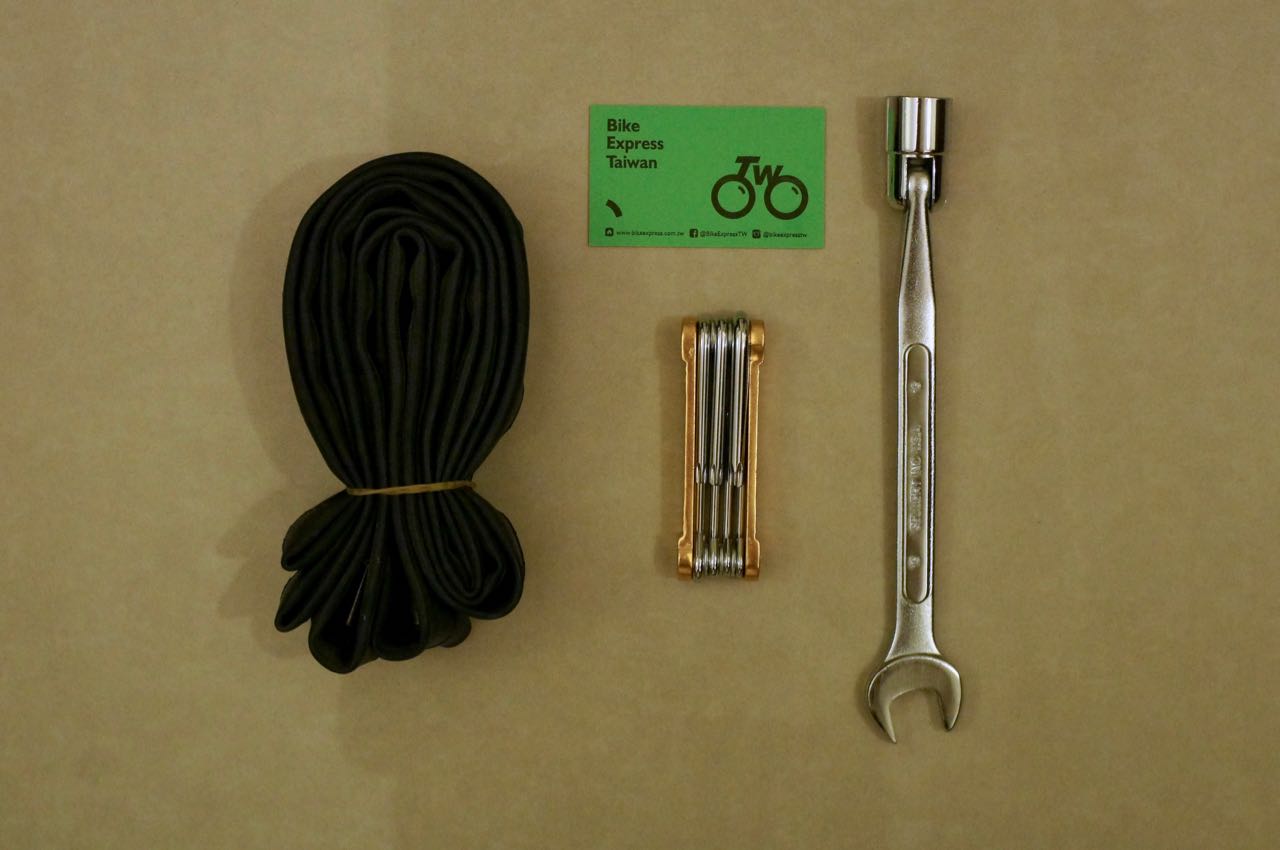
    Next, time for some more serious testing. Now that I have electrical power at my disposal, I could be more ambitious when I was planning my routes. We want to see if it’s good for bike-touring. Lois and I used to cycle for about 50km a day without much climbing when we were bike-touring. We are both not competitive riders and we stop (for breaks, for sightseeing, for coffee, for snacks…) a lot. We may be able to cover more ground with an e-bike. I planned two routes, but first, I need to learn how to replace a tube in case of a flat tire. The tires of the Klever e-bikes are so sturdy a flat tire or punctured tire is very rare indeed. But still. Klever Mobility is kind enough to arrange a demo session for me in their workshop. The procedure to change an inner tube is exactly the same as what needs to be done with an ordinary bike, except that the wheels are much heavier, especially the rear one, which has a heavy motor attached to it. The front wheel has a quick release but the rear one is fastened to the dropouts with bolts. The electric plug to the motor is locked with a star screw. So, in addition to the hex keys, a 19 mm socket wrench and a T25 star key are also needed. I will need to make sure I have all the tools with me when I go somewhere remote because, if there is a flat tire and I am not able to fix it, Lois, a licensed but incompetent driver, won’t be able to come save me.

    The first route I rode is a hilly one from Nangang to Ruifan along the County Highway 109 and 106, just to test how well the e-bike can climb. Then I returned home from Ruifan via Provincial Highway 2D (shown on googlemaps as 2丁) and Provincial Highway 5 (total Distance 77km; elevation gain 1,384m; maximum elevation 490m). I weight around 78kg and I packed an extra battery, which make the total weight around 85kg. The BIACTRON motor system has sensors to detect my pedaling force and provides additional push accordingly. With pedal assist at the lowest level, I managed to climb the first 233m peak on the County Highway 109  by shifting the rear gears. It was quite a steep one; I gained 200m in 3.5km. 

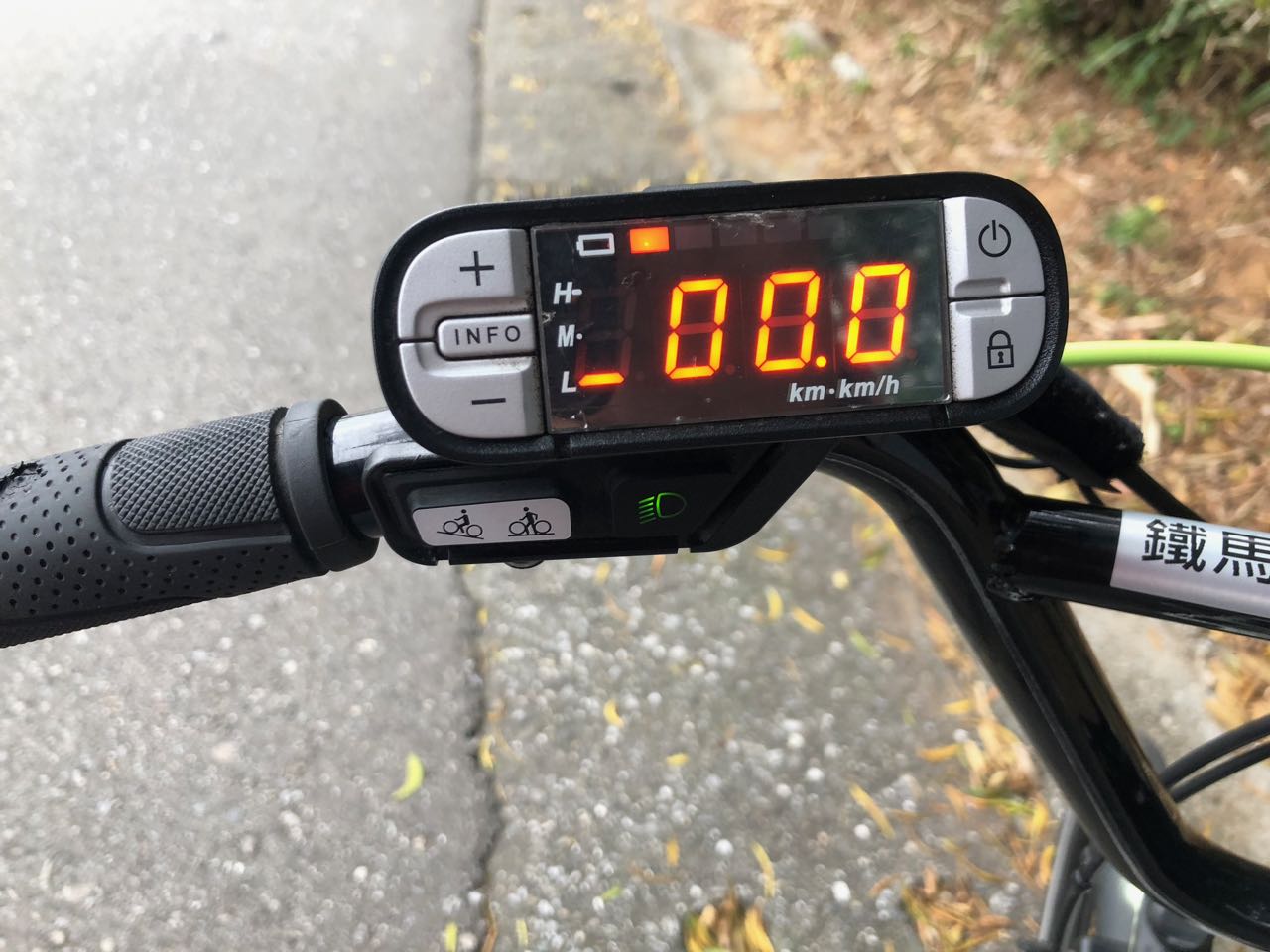
    As I was descending to the junction of the County Highway 106 (elevation 50m), the regenerative coasting was kicked started when the e-bike hit 35km/h. Then there came some steeper descends and I reached around 45km/h. The console beeped to warn me about exceeding the speed limit. Other than that, the e-bike worked quietly. You can hardly noticed any sound coming from the motor.

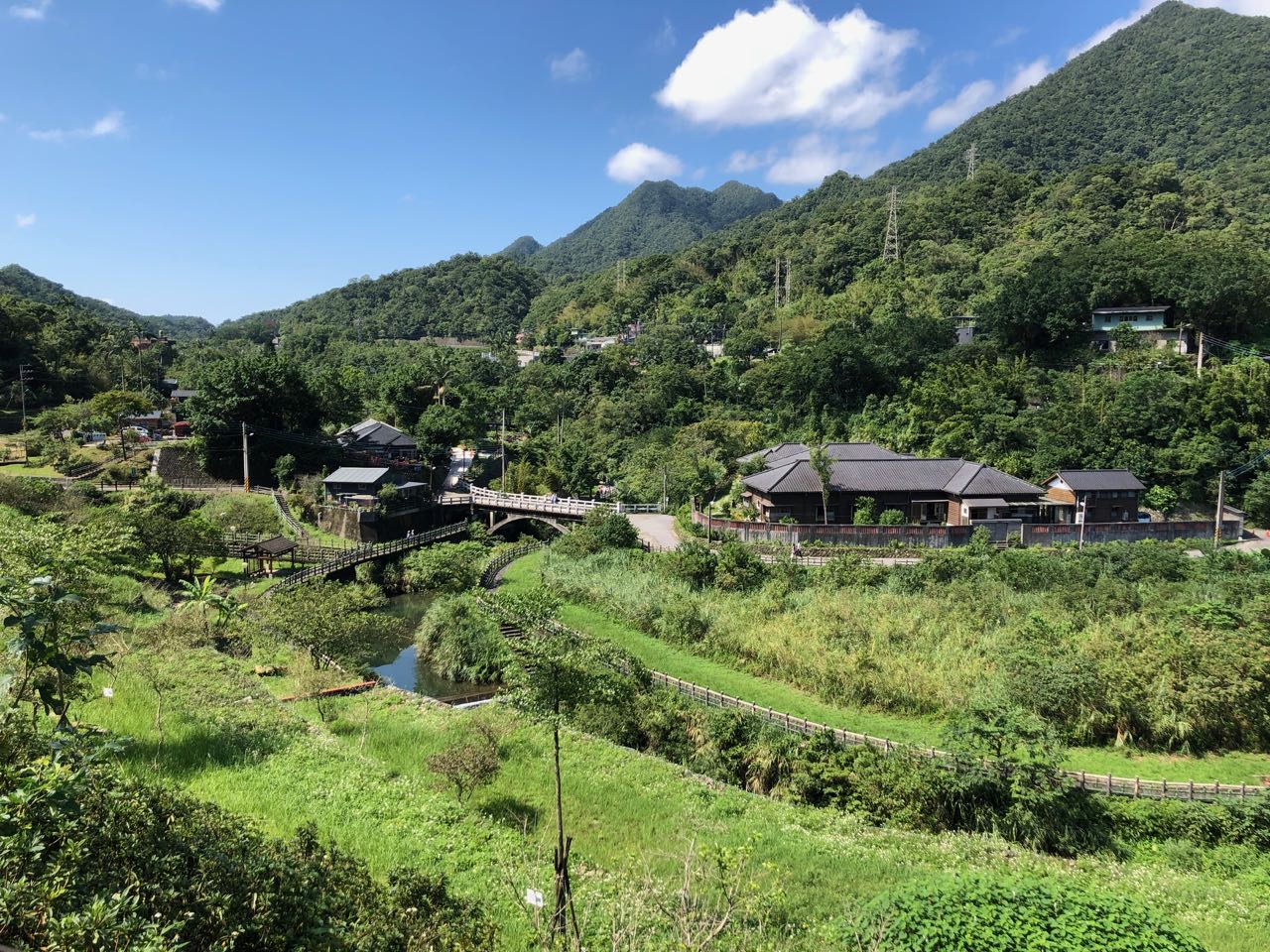
    The next peak was 290m. It was a mild one because it took 13.5km to gain 240m of elevation. I paused frequently to take pictures of the villages in the outskirt, like Shiding, Jingtong, Pingxi and Shifen. It’s in general a very comfortable ride except I had to share the road with the roaring motorbikes. This is a very popular route for bikers, too. 

    The final climb came right after Shifen. I started at  173m of elevation and reached 488m. It was an elevation gain of 315m in 5.8km. At some points, I needed to push the assist level to the highest. The muscles on my legs were getting tired and the battery was coughing up its last bits of power. But we did it. We made it to the top without having to switch to a new battery. I was impressed by its endurance.

    As I was descending to 55m of elevation, on a 10km ride towards Ruifang, the e-bike harnessed some power back to recharge the battery. And I recharged myself with a late lunch at Ruifang. 

    I started my return leg with my fellow old battery. I wanted to see how far it could go. There wouldn’t be any more climbing and I had set the pedal assist to the lowest level. It should be able to last for a bit longer. And that was when a mutiny happened – a cramping leg. Alright! Time to switch to luxury mode. I swapped in the fresh battery and headed home with pedal assist set to a higher. The second battery was still half full when I got home.

    Check out the elevation profile on my Strava link here.
    https://www.strava.com/routes/16388043

    Reference:

    1. https://electrek.co/2018/06/07/electric-bicycle-hub-motors-vs-mid-drive/