Where: Kaohsiung (高雄) to Kenting (墾丁), Taitung (台東) to Hualien (花蓮)
When: 18 Dec – 27 Dec 2012
Who: Peter and Lois (our first cycling trip)
We left Dapeng Bay (大鵬灣) and cycled for another hour and decided to find a place to stay for the night. We found a small homestay in Fangliao (枋寮) on Google Maps.
This little town was formed by loggers from Fujian during the Qing dynasty (1683-1895). Its train station was built, as the terminus of the Pingtung Line (屏東線), when Taiwan was under Japanese rule (1895-1945). The South-link Line (南迴線) was then opened on 1991, connecting the east side of the island to the west. And that was how we would travel to Taitung after we had cycled to Kenting and then returned here by coach in 3 days. It became a small hub connecting Taitung, Kenting and Kaohsiung.
We took a 15-minutes stroll from the train station and found this fishing port. It was peaceful and quiet.
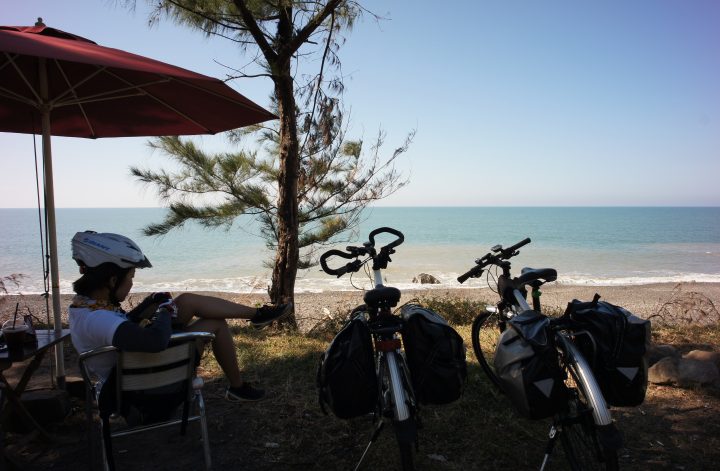
The homestay is part of a bicycle shop, with the guest rooms located on the second floor. It is actually quite convenient for getting maintenance, bike parts and supplies. We bid farewell to Fangliao the next day and headed to Kenting. The road is wider and flatter with less traffic. There were mobile cafes along the way on the sea side. We couldn’t help taking longer breaks and detouring a lot. But this left us little time and strength for the remaining trip, and there were quite some slopes in the last 10km. That was really exhausting.
We finally made it to the hotel we had booked, the Seawall Inn in Kenting, after riding 120km from Kaohsiung in two days. We were so proud of ourselves and were not at all embarrassed by the fact that many cyclists could do this within one day. Actually, in one day, some can even make it to Kenting from Fuguijiao Lighthouse (富貴角燈塔), the northernmost tip of the Taiwan island, in a cycling challenge called One-Day Twin Tower (一日雙塔). The total distance is 520km. Mr. Ko Wen-je, the mayor of Taipei, completed the challenge in 2016 at the age of 57. Although we were exhausted, we ran out to take pictures of the sunset after dropping our luggages in the hotel. We would be staying here for two days to let our muscles recover and do some tourist things.
This is Eluanbi Lighthouse (鵝鑾鼻燈塔), the other ‘tower’ besides Fuguijiao Lighthouse in the One-Day Twin Tower challenge. First constructed in 1882 during the Qing Dynasty to guide the ships away from the hidden reef nearby, it was the only armed lighthouse in the world to fend off frequent raids by local aboriginal tribes at that time. It had been damaged and rebuilt twice during the First Sino-Japanese War and World War II, respectively. What you see in the picture now was re-built in 1962. We took a break from the bicycle pedals and hired electric scooters to explore the peninsula and visit the southernmost tip of the Taiwan island.
We have been to a lot of fishing ports and beaches in Taiwan, including the Houbihu Fishing Port (後壁湖漁港) in Kenting. The clam soup never fails to impress us with its sweet freshness. After moving to Taipei in 2017, we were astonished to find that those vacuum-packed clams on the chilled shelves of the supermarkets are actually alive and will wake up from their long sleep when put in water. Sashimi can be found in many restaurants, big or small, which is probably the legacy of 50 years of Japanese rule. One of the tourist spots in Kenting is called Chuhuo Special Scenic Area (出火景觀). Fire fueled by natural gas has been burning for more than 40 years . We borrowed some heat from it and made ourselves some popcorns. There are tombs scattered around in the area and may horrified some unprepared eyes. One lady who shared a car with us was so scared that she had returned to the hotel immediately. Well, it wasn’t that bad. Don’t worry.
Where: Kaohsiung (高雄) to Kenting (墾丁), Taitung (台東) to Hualien (花蓮)
When: 18 Dec – 27 Dec 2012
Who: Peter and Lois (our first cycling trip)
Goal: To ride on the Southern part of Taiwan and the sea route of Taitung-Hualien. Two legs separated by a two-day rest in Kenting. As traffic in Taiwan moves along the right side of the road, we planned our route anti-clockwise in order to get closer to the sea, even though we would have to ride against the prevailing North East wind from Taitung to Hualien.
Accommodation: We reserved hotels or homestays in the first and last stops of the two legs. In between those, while we were on the road, we would find places to stay by checking out Google Maps or try our luck with the small advertising flyers stuck to bare walls or lamp posts by homestay owners nearby.
Mobile Data: Prepaid SIM card
Navigation: Google Maps
Kaohsiung city is the 3rd most populous city of Taiwan with around 2.77 million people. Its airport, which is the 2nd largest international airport in Taiwan, is connected to the Kaohsiung Rapid Transit, which will bring you to the city centre within 30 minutes at a fair price. It’s our first time in the city. We spent the first half-day roaming around the city. Most bicycle shops open after 11:00 am. We were not able to get our bicycles earlier and embark on the journey. So, we decided to spend the night in the city.
Night markets are one of the highlights of traveling in Taiwan. While most restaurants are closing down at 9:00 pm, business of those tiny stalls selling various xiaochi (literally means bite-size snacks) in the night markets is peaking. The food is tasty while the price is cheap. The only problem is our stomach is not bottomless. Our strategy? Take a walk to check out all the stalls first. Make a list of all the items you want to try. Evaluate and eliminate, then start munching! My personal favorite: stewed pork legs.
We brought a pair of walkie-talkies for communicating with each other when cycling. Are we going to turn right or turn left? Should we detour to check out that seemingly interesting site? Would you like to stop for some snacks or take a toilet break? All these can be discussed and decided without having to stop. We don’t need to hit the brake, wearing the braking pads thin, and let our momentum turn into wasted heat just to get a simple yes or no. We found two headsets with talk buttons that we can attached to the handlebar. That way we could keep our hands on the handlebar while we wanted to talk. Safety comes first.
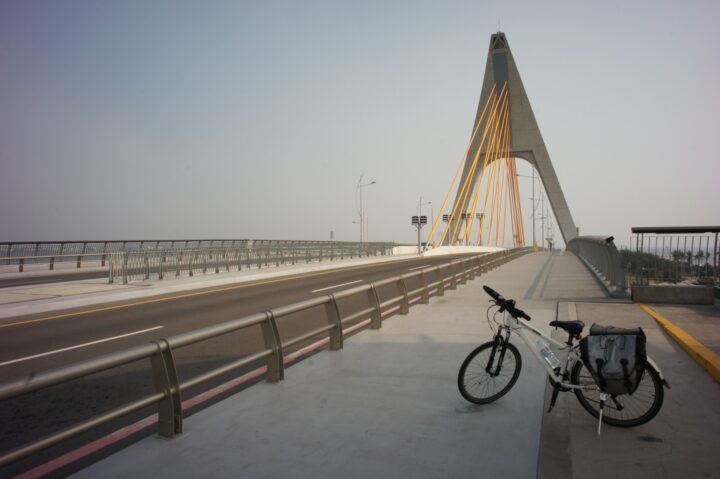
Sea views! We love sea views! However, even cycling on the roads closest to the sea doesn’t necessarily guarantee that you can see the sea. Usually, it was blocked by levees or buildings. We followed Google Maps and mainly rode the Provincial Highway No. 17 from Kaohsiung city to Fangliao Township. Most of the time when one sees the bikeway signs, like the one here in Dapeng Bay (大鵬灣), it’s worth the trouble to check it out. The sea view was most welcomed.
Who: Peter and fellow cyclists who joined the group tour organized by Bike Explorer Club 山海戀單車俱樂部
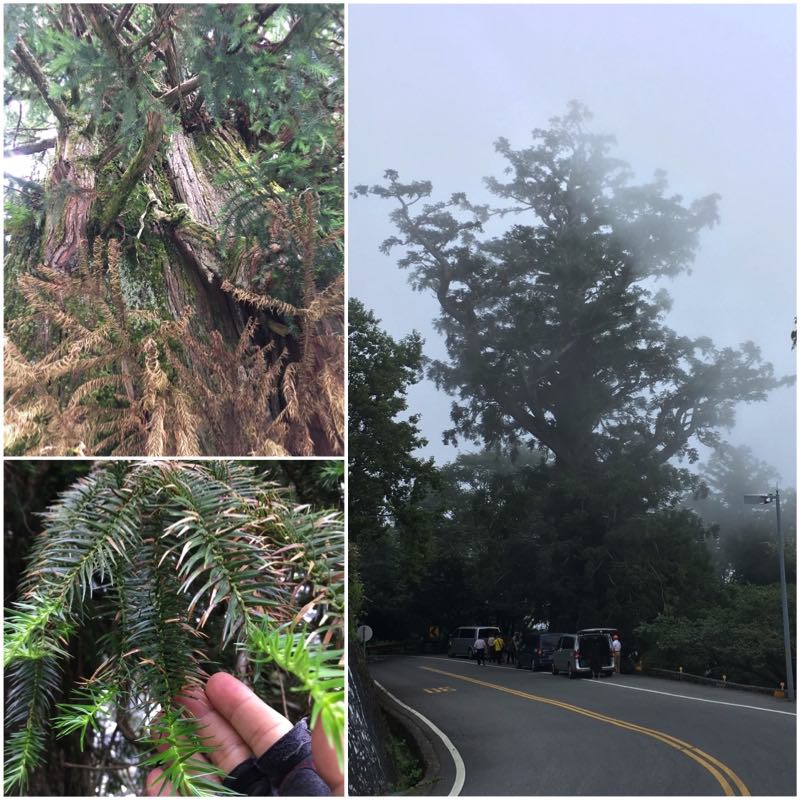
This fir (巒大杉 Cunninghamia lanceolata var. konishii) can be found at around 127.6 km of Provincial Highway No. 8. It is more than 3000 years old and around 50 metres tall.
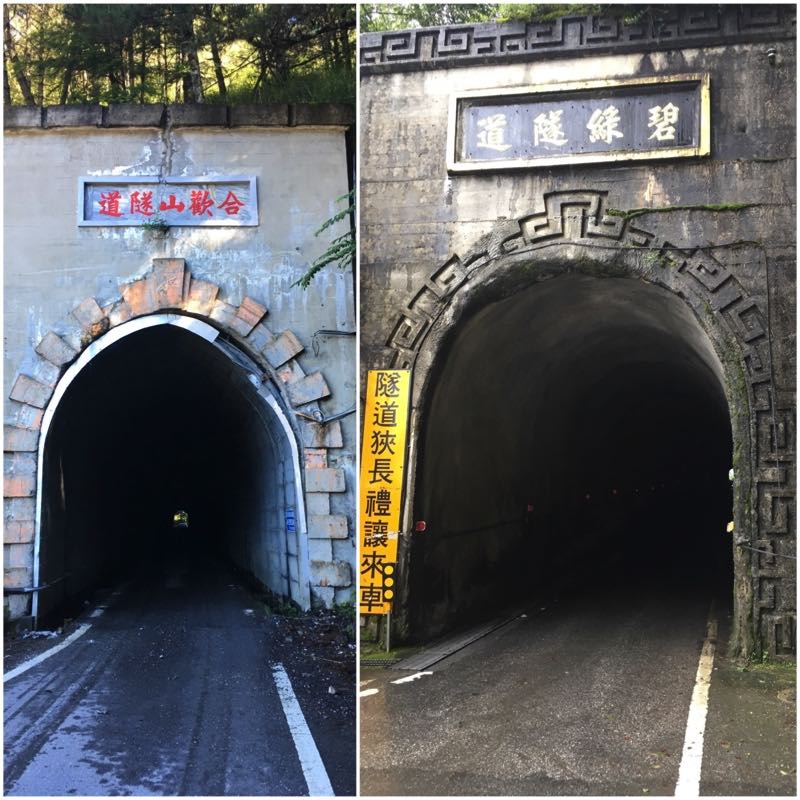
It must have been hard to build these roads, especially the numerous small tunnels, yet the designers did not make compromises on aesthetics. The entrances are decorated with beautiful patterns.
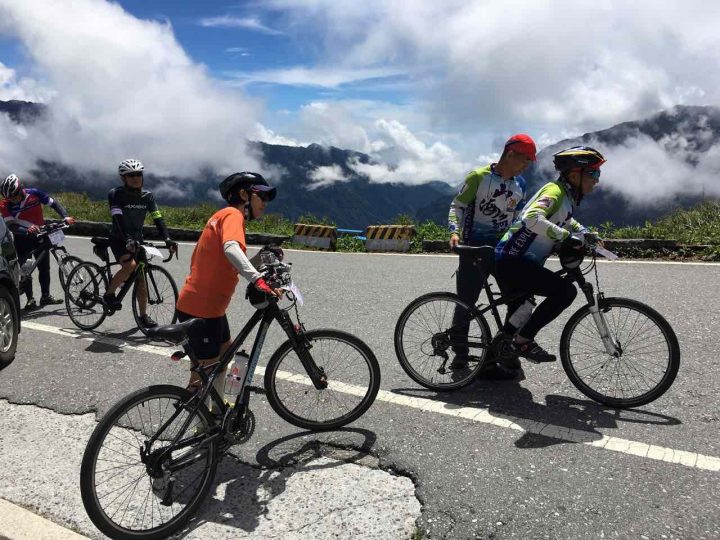
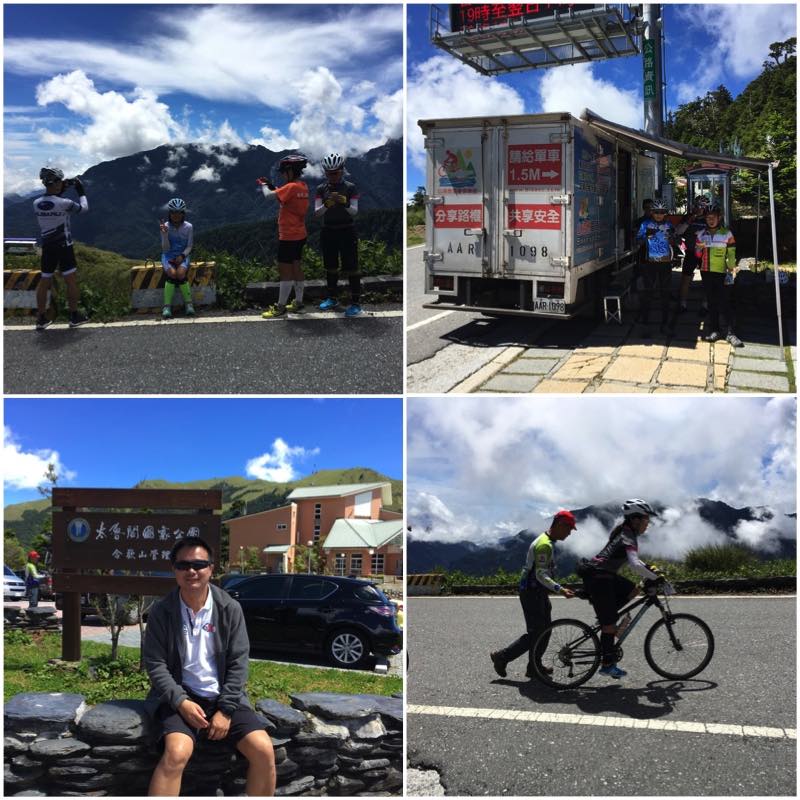
The Acacia Hill Station (合歡山管理站 elevation 3002 metres above sea level ) was the last stop before the team reached Wuling. We were at the same level of the clouds. The air was cool and had a unique taste of freshness. It’s a busy spot where campers, hikers and cyclists gather. Our coaches had to give us a push to help us balance upon starting – it’s easy to lose balance when the roads are so steep, and if you do, you will likely force your muscles a bit too much, which may trigger spasm.
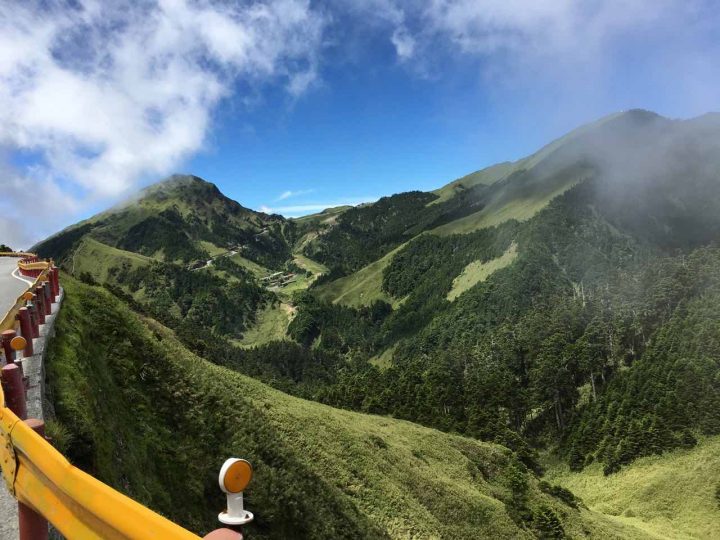
Made it to Wuling (elevation 3275 metres above sea level), finally! It’s a great achievement! We were so lucky that the weather was so fine. The downhill ride was more dangerous and tricky. For some cyclists, it is good enough to do the climb on bike and go home by car. But for some, it is not even enough to do the whole trip once. There is the so-called “Wuling Double” (雙進武嶺) challenge, in which people head up to Wuling from Tianxiang (66km, ascending 2825 metre) and then down to Puli (55 km, descending 2826 metres) on the first day, and return to Tianxiang via the same route on the second day! To me, bicycle is a means to explore the world. I always plan my routes to minimise changes of elevation in order to make the ride easier. The thought of maximising its difficulty had surely not crossed my mind before.
We descended to a nice Japanese style resort in Qingjing (清境, elevation 1607 metres). Everyone was so thrilled about what they had achieved. We had a sharing on the roof about our own story with cycling. The team included some local Taiwanese, a Singaporean, and some marathon runners and one cyclist from Hong Kong. I was so surprised to learn that most of my team mates had only been cycling for around 5 years. A couple retired locals told us that cycling had healed their ageing bodies. It made them young. No doubt it is! They did much better than me in the trip. I seized the last chance to ride on the final day after making sure my hip joint was fine. Yeah, it’s much more fun to cycle than just sitting in a van.
Conclusion:
Lois and I love travelling on bicycles, but we had never joined a cycling tour before. We used to just roam along the routes at our own pace, and we would change our plan anytime. Must say we are both free spirits. What we need is someone to provide us the bicycles and take them back at the end of our trip, at the time and place that is most convenient for us. And this is the key service we provide at Bike Express Taiwan.
Freedom comes at a price, of course. Without an organiser, we need to do all the planning and booking ourselves, probably paying more. Without a support car, we need to carry all our luggages by ourselves and have to plan more conservatively to avoid exhausting or even injuring ourselves. So, if all you want is cycling and sightseeing, you’d better join a cycling tour and let someone else worry about the rest.
Where: Luodong, Taroko, Wuling, Qingjing, Puli Township. The route of KOM challenge in Taiwan.
When: 30 June – 3 July 2017
Who: Peter and fellow cyclists who joined the group tour organized by Bike Explorer Club (山海戀單車俱樂部)
Goal: To get to Wuling Pass (elevation 3275 metres above sea level, Taiwan’s highest road) from Xincheng Taroko Station (elevation 36 metres) on bicycles in 3 days. This 106km route is usually done in several hours by participants during the KOM challenge.
No luggage on the bicycle for this 4-day trip. All were taken care of by the support vehicles. They were also loaded with beverages and energy food to be served at every rest stops.
The first half-day we cycled on the flat scenic country roads to warm up before embarking on the challenging climb. The Dongshan Township has quite a number of tourist attractions to offer. We cycled along the Dongshan River Bikeway to the Dongshan Train Station, which has a cover like a melon trellis. Then The Sanqi Village offered a vast view of paddy rice fields. They even built a viewing platform for visitors.
We were supposed to approach Wuling Pass from the north (北進武嶺). At least this was what I had signed up for. It’s the least steep one, I supposed. Unfortunately, right before our trip started, part of that route were ruined by typhoon, and we had to take the east route instead. We took the train from Su’aoxin Station (蘇澳新站) to Xincheng Taroko Station (新城太魯閣車站). It is a 80km trip covered by train without any climbing. Looked like it’s going to be very steep ahead. Some cyclists I met said that approaching Wuling Pass from the west has endless ramps to climb, while doing it from the east is like climb walls.
We spent the afternoon climbing on the Provincial Highway No. 8 from Xincheng Taroko Station to Tianxiang (天祥, elevation 476 metres ), a 22km ride with a total climbing of 1,370 metres. It’s a road/semi-tunnel carved out of the rocks of the Taroko gorge. Very impressive! Therefore the saying goes, “If you have not been to Taroko, you have not been to Taiwan”. I hired a car and drove on this road years ago. It was a different experience. I did not know that I can climb the road with a bicycle there.
Endless climbs for the next day. The moment I stopped pedalling, my bicycle started retreating. It was hard to tell by sight how steep the road actually is as it goes zig-zag all the way up. But you could use a cup of water to show the tilt. Though I managed to ride using the lowest gear, I was moving no quicker than on foot. My plan was to stay on the bicycle as long as possible (because it’s a cycling tour after all), but unfortunately I was told to hop on the support van or I wouldn’t have time for lunch. So, that was me looking completely exhausted in the van. While I was trying to help myself to food with shaking hands at Sinbaiyang (新白揚, elevation 1644 metres above sea level), the other guys were already done with lunch and taking a nap. And that’s it for me. After cooling down, I found myself unable to walk properly because of an aching hip joint. To avoid leaving permanent damage, I decided there would be no more cycling for the afternoon and the next day. I would get to Wuling sitting comfortably on the van. Anyway, I had already climbed around 3400 meters. My personal best.